

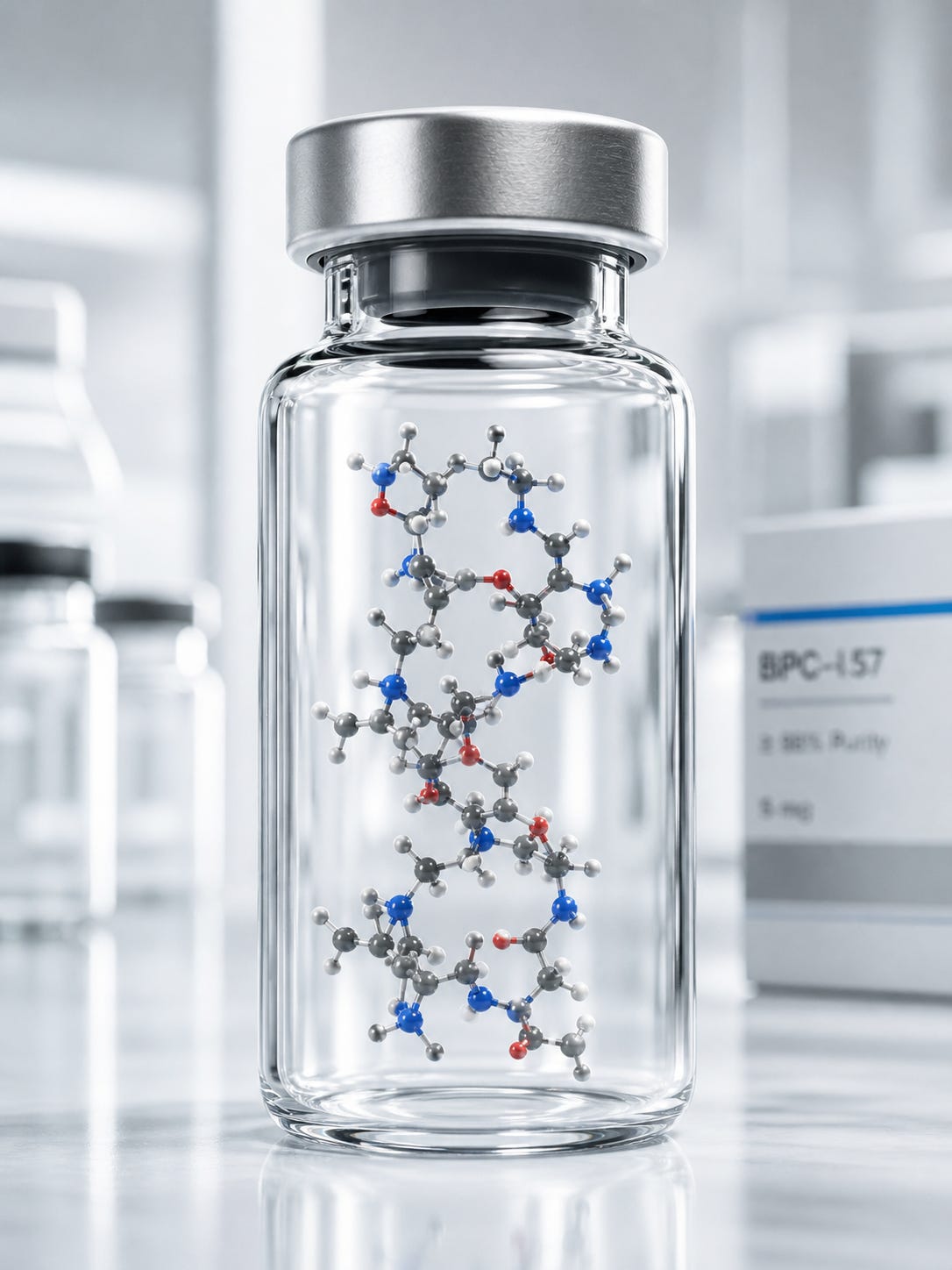
A 55-year-old has been managing a partial rotator cuff tear for eighteen months. Physical therapy has plateaued. Surgery is the next conversation. A functional medicine physician offers another option. Four hundred micrograms of BPC-157, injected twice daily for six weeks.
The patient asks for the human evidence at that dose for that injury. The literature has no answer.
The FDA’s procedural reopening does not change that.
If you enjoy these posts, consider subscribing and becoming a part of our growing community!
Your body runs on peptides. Insulin is one. Oxytocin is one. The GLP-1 drugs everyone is taking for weight loss are synthetic versions of a peptide your gut secretes after a meal.
Peptides are short chains of amino acids, anywhere from two to about fifty, that act as signaling molecules. Smaller and more targeted than the proteins that build tissue. Larger and more specific than the small-molecule drugs that fill most prescriptions.
A different class of peptides has spent the last three years in regulatory limbo. Compounds like BPC-157, a fragment of a stomach protein that appears to accelerate tissue repair, were available through compounding pharmacies until the FDA restricted them in late 2023 under its Category 2 listing. They moved to the gray market. Functional medicine doctors, athletes, and longevity clinics built protocols around them anyway.
The FDA recently reopened review of these compounds. In April 2026, twelve peptide nominations came off Category 2 after the original nominators withdrew them. The agency simultaneously scheduled advisory committee meetings for July 2026 and early 2027 to consider whether some should be formally added to the 503A bulks list, the list of substances licensed compounding pharmacies may legally use. Withdrawal from Category 2 is not the same as authorization. The compounds sit in a procedural in-between, neither flagged as high-risk nor cleared for compounding, pending the advisory review and FDA’s eventual response to it.
Compounding pharmacies are not drug manufacturers. A 503A compounding pharmacy mixes a specific medication for a specific patient on a doctor’s prescription, using raw active pharmaceutical ingredients tested for sterility, potency, and identity. The peptides in question are not FDA-approved drugs. The 2023 Category 2 listing told compounding pharmacies they could no longer prepare them. Withdrawal from Category 2 removes the explicit safety-risk flag but does not by itself authorize compounding.
BPC-157 is the most sought-after of the group. Fifteen amino acids, derived from a fragment of a human gastric protein (Sikiric et al., 2016). The mechanism is plausible. It activates VEGFR2 to drive new blood vessel formation. It increases nitric oxide production. It dampens inflammatory cytokine signaling.
Animal studies, predominantly from a single research group in Croatia, show accelerated recovery across muscle, tendon, bone, gut lining, nerve, and vascular tissue (Chang et al., 2011). Independent groups have reproduced pieces of the picture, but the bulk of the animal package still rests on the original Croatian work.
The human data is almost nothing. The published human trials cover a handful of studies and fewer than three dozen subjects. The animal signal is not the weak point. The compound does something. What it does in that 55-year-old patient at that dose for that injury remains unanswered.
The other returning compounds sit on similar foundations. TB-500 is a synthetic fragment of thymosin beta-4, an actin-binding peptide that promotes cell migration and tissue repair (Goldstein et al., 2012). The parent molecule has been studied in small human trials for skin ulcers and cardiac injury. The fragment that compounding pharmacies prepare is not identical to the parent, and the human data on the fragment is thin. Semax and Selank are Russian-developed nootropic peptides, derivatives of ACTH and tuftsin, with decades of clinical use in Russia and small human trial packages well short of a U.S. NDA (Koroleva and Myasoedov, 2018).
Epitalon is a four-amino-acid pineal peptide with in-vitro reports of telomerase activation in human somatic cells (Khavinson et al., 2003). KPV is an anti-inflammatory tripeptide studied mostly in animal models of inflammatory bowel disease. MOTS-C is a mitochondrial-derived peptide with academic interest in metabolic regulation and almost no clinical trial data.
These compounds act on repair, inflammation, and stress response pathways that do not fit the single-indication logic of FDA drug approval. That structural mismatch is why the literature looks the way it does.
FDA approval for a new drug runs around a billion dollars and takes a decade. Composition patents run twenty years from filing. By the time any company cleared an approval pathway for an old peptide, the patent protection would be gone. No exclusivity means no return on investment. Companies do not run billion-dollar trials on molecules they cannot profitably sell.
Pleiotropy compounds the problem. The word means a molecule acts across multiple tissue types through overlapping mechanisms. BPC-157 fits that pattern.
The FDA pipeline requires approval for a single disease indication. A molecule that does many things moderately well does not fit a system designed to prove one thing definitively. Compounding pharmacies prepare these peptides cheaply. Pharmaceutical companies cannot justify the investment.
The result is a regulatory dead zone. The compounds are too well-known to ignore and too unpatentable to develop.
Pharma does not study what it cannot sell. A molecule that cannot cross that economic threshold stays in animal models and small university trials. If it works, it works quietly, in clinics where the compounding supply exists. If it does not work, nobody finds out through a phase 3 readout. Nobody finds out at all.
The 2023 restriction collapsed the legal supply. Demand did not collapse with it. Testing of gray-market peptide products has documented variability in active content, bacterial endotoxin contamination, and in some cases entirely wrong compounds. If FDA eventually adds some of these compounds to the bulks list, demand will migrate back toward licensed pharmacies. That has not happened yet.
A compounded peptide from a 503A pharmacy comes with a physician prescription, USP-grade active ingredient, tested endotoxin levels, and a labeled concentration that matches the vial. A peptide from an Instagram vendor comes with none of those guarantees. Same molecule. Different manufacturing.
For the rotator cuff patient and the prescribing physician, the questions that matter are unchanged by category reclassification. What is the dose rationale at this body weight and indication. What is the best human evidence at that dose. Is the prescribing physician tracking measurable outcomes or operating on testimonial. What is the exit criterion if there is no improvement in eight weeks.
The procedural reopening does not answer any of them. They are answered at the level of the patient and the clinic.
A pleiotropic, off-patent compound will never pay back a billion-dollar approval trial. Academic consortia could run mid-sized trials, but the incentives for grant-funded investigators to study a compound with no pharma sponsor are weak. Patient registries and real-world evidence programs could plausibly produce usable data at a fraction of the cost, if anyone funded them.
That is the pathway compounded peptides need. Neither the administration that restricted them nor the one reopening them has moved toward it. The science will not settle itself. It has to be paid for, and nobody with the money has a reason to pay.
These newsletters take significant effort to put together and are totally for the reader’s benefit. If you find these explorations valuable, there are multiple ways to show your support:
Engage: Like or comment on posts to join the conversation.
Subscribe: Never miss an update by subscribing to the Substack.
Share: Help spread the word by sharing posts with friends directly or on social media.
References
Sikiric P, Seiwerth S, Rucman R, et al. Brain-gut axis and pentadecapeptide BPC 157: theoretical and practical implications. Curr Neuropharmacol. 2016;14:857-865. doi: 10.2174/1570159x13666160502153022
Chang CH, Tsai WC, Lin MS, Hsu YH, Pang JH. The promoting effect of pentadecapeptide BPC 157 on tendon healing involves tendon outgrowth, cell survival, and cell migration. J Appl Physiol. 2011;110:774-780. doi: 10.1152/japplphysiol.00945.2010
Goldstein AL, Hannappel E, Sosne G, Kleinman HK. Thymosin beta4: a multi-functional regenerative peptide. Basic properties and clinical applications. Expert Opin Biol Ther. 2012;12:37-51. doi: 10.1517/14712598.2012.634793
Khavinson VKh, Bondarev IE, Butyugov AA. Epithalon peptide induces telomerase activity and telomere elongation in human somatic cells. Bull Exp Biol Med. 2003;135:590-592. doi: 10.1023/a:1025493705728
Koroleva SV, Myasoedov NF. Semax as a universal drug for therapy and research. Biol Bull. 2018;45:589-600. doi: 10.1134/S1062359018060055
That sounds like stem cell therapy. It must have a different mechanism of action, though, because the ortho surgeon I saw about my rotator cuffs didn't mention stem cells. Maybe he wasn't familiar with peptide treatments, or not willing to risk using something without human trials evidence behind it. I'd have done the surgery just because I associate surgery with awesome drugs, but the recovery period is insane. No fleeting post-anesthesia high is worth that.
What do you think of peptides overall?