

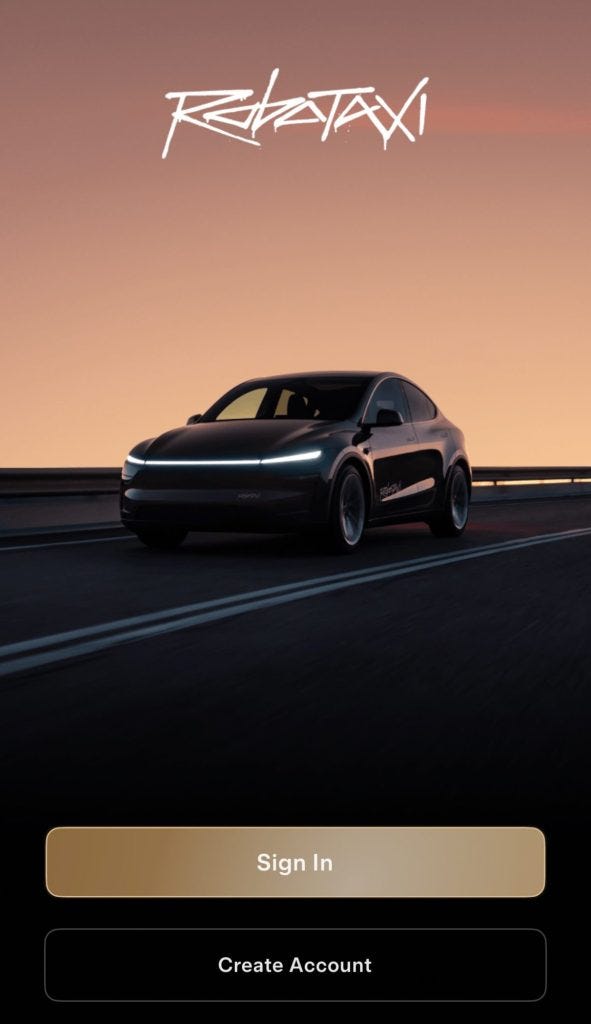
Tesla’s long-awaited RoboTaxi, well, at least a version of it, has finally launched. It’s exactly what it sounds like: a self-driving taxi summoned through a ride-hailing app, like Uber or Lyft. While that’s undeniably exciting, there are some caveats: this is a very limited rollout, and it’s not yet the CyberCab model we’ve all been waiting for.
Okay, I’m done being petulant, because this is, without question, a major milestone. Not just for Tesla, but for the transportation industry as a whole. This may very well mark the beginning of the end of human-driven cars if Waymo hasn’t already made that clear. Of course, they won’t vanish overnight. But by the end of this article, I think you’ll agree: this launch is strong evidence that we’re entering a new era of transportation—one shaped by automation, robotics, and artificial intelligence.
It’s part of a broader inflection point we’re living through. But that’s a topic for another piece.
Before we get into the article, let me first ask a quick question:
Level 1 (Driver Assistance):
The vehicle can assist with steering or acceleration/braking (e.g., adaptive cruise control), but the human must monitor and control all other driving tasks.
Level 2 (Partial Automation):
The vehicle can control both steering and acceleration/braking simultaneously under specific conditions, but the human driver must remain attentive and ready to intervene at all times.
Level 3 (Conditional Automation):
The vehicle manages all driving tasks within certain conditions (like highway driving), allowing the driver to disengage temporarily, but the human must be ready to take over when alerted.
Level 4 (High Automation):
The vehicle fully handles all driving functions within specific areas or conditions without requiring human attention, but cannot operate autonomously everywhere.
Level 5 (Full Automation):
The vehicle can independently perform all driving functions under all conditions and environments without any human input or supervision.
Let’s dive in.
First, if you enjoy these updates, consider subscribing and becoming a part of our growing community!
Tesla has finally launched its first real-world robotaxi service – in a limited pilot on the streets of Austin, Texas (note: as someone who lives in a different city, this has made me quite jealous). In late June of this year, a small fleet of around 10 Model Y SUVs began offering autonomous rides within a roughly 20-square-mile geofenced zone of South Austin. Uniquely, no one sits in the driver’s seat during these rides; instead, a Tesla employee acts as a “safety monitor” from the front passenger side. The car drives itself while the monitor is on hand to intervene if needed, though notably, they have no steering wheel or pedals in front of them, as the vehicle is fully controlling the drive. The pilot program is by invitation only (limited to select early testers and Tesla-friendly influencers) and rides are hailed via Tesla’s app. In classic Musk fashion, each trip costs a flat $4.20 regardless of distance. This Austin rollout marks Tesla’s first driverless ride-hailing service after years of promises, albeit in a tightly circumscribed trial for now.
Tesla’s Unique Approach: Vision Only, Full Stack
Tesla’s robotaxi strategy diverges sharply from the approaches of rivals like Waymo, Cruise, or Zoox. Key differentiators include:
Vision-Only Autonomy – No lidar or radar. Tesla is famous (some say notorious) for its camera-centric self-driving strategy. The Austin Model Y robotaxis depend solely on eight cameras and AI neural networks to navigate, eschewing the expensive lidar and radar sensors that most other autonomous vehicles rely on. This pure vision approach reflects Musk’s belief that cameras should be sufficient for navigation in the same way vision is exclusively used for human navigation.
Vertical Integration – Tesla controls the entire stack: it designs the self-driving software and builds the cars. This in-house, vertically integrated model leverages Tesla’s mass-manufacturing capacity and tech expertise. Unlike Waymo, which retrofits third-party vehicles with expensive sensors, Tesla can tightly integrate its hardware and software. (Waymo, for example, buys Jaguar I-PACE SUVs and outfits them with a custom lidar/radar suite – a much pricier, bespoke setup than Tesla’s built-in system) Tesla’s autonomy platform runs on the company’s own FSD computer chips inside each vehicle, all engineered under one roof.
Consumer-Grade Fleet (Model Y, not Custom Pods) – Rather than deploying quirky purpose-built shuttles, Tesla is using standard production vehicles as robotaxis. The pilot cars in Austin are essentially stock Model Ys, “unmodified Tesla cars coming straight from the factory,” as Musk noted, meaning every Tesla sold is already hardware-ready for self-driving with just a software update. This approach stands in contrast to competitors developing dedicated robo-taxis (like Cruise’s Origin or Zoox’s carriage-like pod). Tesla’s bet is that millions of ordinary Teslas on the road could be instant robotaxis once the software matures, without needing special hardware.
Over-the-Air Updates – Tesla pioneered over-the-air (OTA) software updates, and it’s a core advantage in the autonomy race. Improvements to the Full Self-Driving (FSD) software can be beamed directly to Tesla cars regularly, allowing the company to iterate quickly and scale new self-driving capabilities to its whole fleet overnight. This software-centric philosophy of treating the car as a “platform” that improves over time is something traditional automakers and even other AV companies have struggled to match. It means Tesla could fix bugs or upgrade driving behaviors across thousands of robotaxis without ever pulling them off the road for physical tweaks.
The Roadmap Forward from Model Y to Cybercab
Originally, Tesla’s Cybercab prototype, a two-seater EV with no steering wheel or pedals, was unveiled in late 2024. The company plans to launch this dedicated robotaxi model sometime next year in 2026.
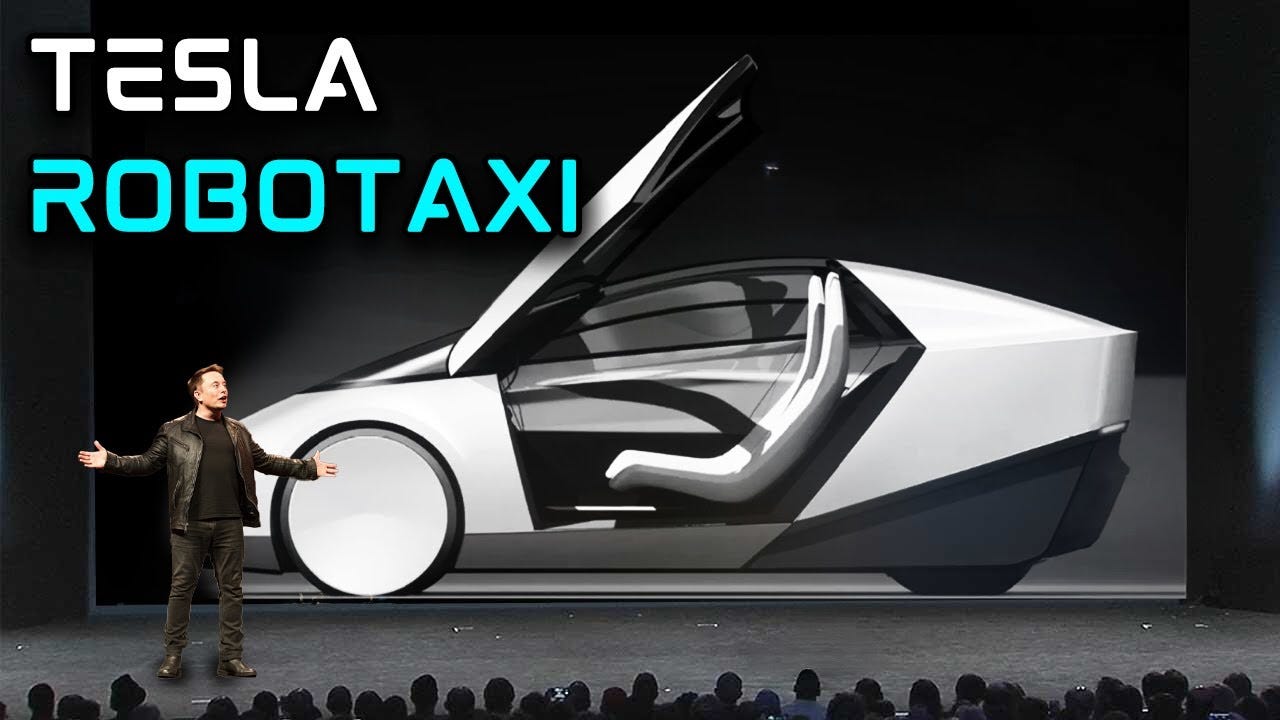
This Austin pilot is just the beginning. Tesla is already planning a next-generation robotaxi vehicle known as the Cybercab, targeted for debut in 2026. Elon Musk unveiled a prototype of the Cybercab last year – a sleek two-door, two-seat electric car with no steering wheel, no pedals, and dramatic “butterfly” doors. The Cybercab will be a purpose-built autonomous taxi, designed purely for driverless travel (in fact, it cannot be human-driven at all). If Tesla hits its timeline, we could see these futuristic two-seaters joining the robotaxi fleet in the coming year.
Beyond new vehicles, Musk’s ultimate vision is to unlock autonomy at scale. The long-term plan is to enable any Tesla with the FSD package to operate as a robotaxi, earning money for its owner when not in personal use. In other words, your Tesla could drive itself out to give rides and generate revenue while you’re at work or asleep. Musk has hyped this scenario for years and reiterated it recently, predicting “millions of Teslas operating fully autonomously” by late 2026. Achieving that will be enormously challenging – it means going from a dozen test cars to a global network of self-driving Teslas in a short time. Tesla will need to greatly refine its FSD software (and prove its safety) before regulators would ever allow a mass rollout. Nonetheless, the company is pushing ahead: it views the Austin trial as a crucial proof-of-concept, after which it can iterate the software quickly via OTA updates and gradually expand the service area and participant pool. If things go well, Tesla hopes the combination of better AI and millions of existing vehicles will let it scale up far faster than competitors have.
Tesla vs. Waymo and The Race for Robotaxi Dominance
Finally, no discussion of robotaxis is complete without Waymo, the current front-runner in autonomous ride-hailing. Waymo (Google/Alphabet’s self-driving unit) is several years ahead in deployment: it now operates over 1,500 driverless cars across multiple cities, including San Francisco, Los Angeles, Phoenix, and (recently) Austin. Waymo’s vehicles use a very different tech stack than Tesla’s – they’re equipped with an array of lidar, radar, and high-precision maps to navigate, and the service runs fully driverless (no human safety operator in the car) in its active markets. By 2023, Waymo was already offering rider-only robotaxi trips in San Francisco and Phoenix, logging over 10 million miles of autonomous driving with no one behind the wheel. This head start has given Waymo a trove of real-world data and experience, as well as a rapport with regulators in those cities.
Tesla, on the other hand, is just entering the fray now with a handful of cars and an employee still in the front seat. Tesla is betting that its cheaper, software-first approach will ultimately outscale Waymo’s. Instead of custom sensor-laden vehicles, Tesla leverages cost-efficient camera technology and its existing production cars. Instead of geo-fenced HD maps and cautious expansion, Tesla aims to “solve” generalized self-driving AI and deploy it everywhere via software updates. This strategy is highly ambitious. Skeptics point out that Waymo’s slow-and-steady approach has finally borne fruit, and that Tesla’s AI-only system still struggles with edge cases. Still, if Tesla can crack the code, its ability to instantly convert a million customer-owned cars into robotaxis would be a game-changer. Waymo may lead for now, but Tesla is sprinting to catch up, confident that a vertically-integrated, vision-only platform (one that can improve exponentially with data) will win out in the long run. The next couple of years, as Tesla ramps up from this Austin pilot to broader service and as Waymo expands to new cities, will reveal whether Tesla’s grand robotaxi gamble pays off, or if the crown stays with the current champion of driverless tech.
These newsletters take significant effort to put together and are totally for the reader's benefit. If you find these explorations valuable, there are multiple ways to show your support:
Engage: Like or comment on posts to join the conversation.
Subscribe: Never miss an update by subscribing to the Substack.
Share: Help spread the word by sharing posts with friends directly or on social media.
A good read
So... are we officially in the Jetsons era now or we still have to parallel park tomorrow? 😀