



“The arc of the moral universe is long, but it bends toward justice.”
I love this famous quote from Dr. Martin Luther King Jr. It suggests that progress, though slow and sometimes uneven, ultimately trends toward what's right. Almost like there is something inherently unstable about lies, deceit, or other wrongness. On long enough time scales, I do believe this has historically held true in society. Moreover, I think science operates in a similar way. Science is self-correcting—it is built on skepticism, replication, and the willingness to learn from mistakes. It’s why even when missteps and misconduct occur, they only temporarily derail progress.
The arc of science bends inevitably toward reality. Let’s see if you agree by the end of this post.
In many tech startups, the "fake it till you make it" model is common—raising funds first and backfilling the promises later. This somewhat makes sense for engineering problems, where the goal seems fundamentally possible. But in science, particularly in biotechnology and medicine, there is much more uncertainty. Sometimes systems do not behave the way our theory predicts, causing this “fake it till you make it” approach to fall apart. And when it does, it falls hard. Most of us are familiar with Theranos, the fraudulent blood-testing company that burned through billions in investment, leaving behind shattered trust and cautionary tales.
Even in academia and basic research, the pressure to secure grants can incentivize researchers to prioritize exciting results over rigorously obtaining them. At best, this leads to sloppy science. At worst, it enables outright fraud that leaves the field chasing ghosts. Biotechnology requires immense trust, as validation and real-world applications often lag far behind initial discoveries. Yet the stakes remain high, and in both biotech and academia, being first can mean everything.
The Scoop. One of the most seminal stem cell papers, published in 2002, was finally retracted in 2024. What's the story here, and what should we take away from this?
Setting the stage. Back in 1998, the first human embryonic stem (ES) cells were isolated from a human embryo. These ES cells could be maintained in their pluripotent state—capable of differentiating into any cell type in the body. This discovery generated enormous excitement about potential applications in research, regenerative medicine, disease treatment, you name it. However, by 2001, the Bush administration had significantly restricted federal funding for embryonic stem cell research in the United States, tightening the regulatory environment. Many American scientists, eager to be at the vanguard of an emerging field, felt they were stuck with limited paths to pursue ES cell studies.
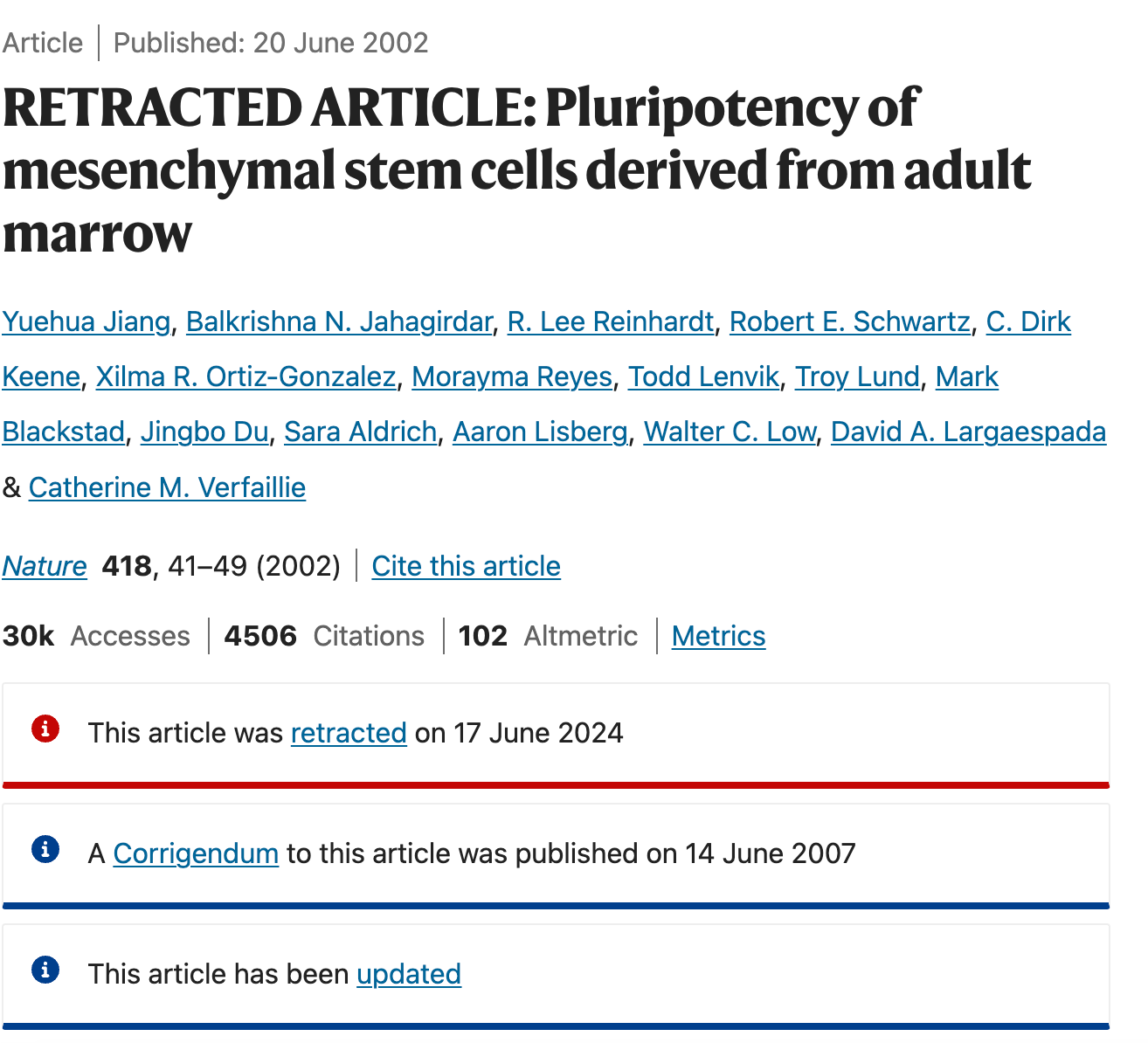
Then, seemingly out of nowhere, Nature published a 2002 paper led by Yuehua Jiang and colleagues in Dr. Catherine Verfaillie’s lab, describing “Multipotent Adult Progenitor Cells” (MAPCs). These were portrayed as a rare subpopulation of bone marrow-derived cells with pluripotent-like properties, a potential holy grail for regenerative medicine that bypassed the ethical controversies surrounding human embryos. If MAPCs could truly become any cell type in the body, as the authors claimed, the impact would be monumental.
Hype and Scrutiny. At first, the study generated widespread excitement, as researchers and biotech companies raced to explore the potential of MAPCs for regenerative medicine. But soon, cracks appeared. Independent labs repeatedly failed to replicate the paper’s most striking claims, especially the ability to generate chimeric animals. By 2007, the study required a major figure correction, acknowledging that some flow cytometry plots had been incorrectly depicted. Despite lingering doubts, the paper remained widely cited for years, even as skepticism continued to simmer quietly in the background.
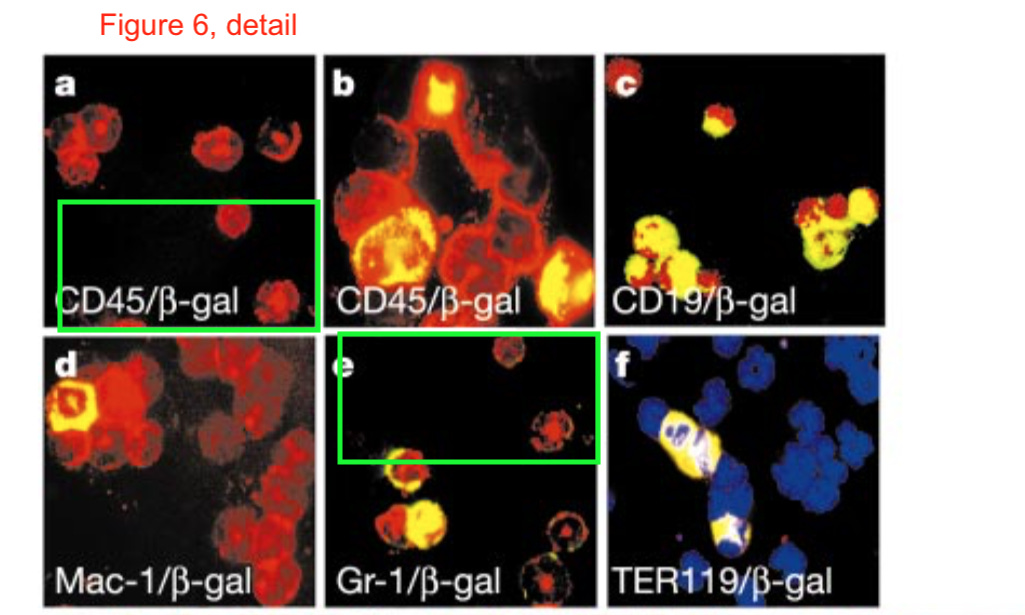
Retraction. It wasn’t until June 2024, 22 years after the paper was first published, that Nature formally retracted the 2002 MAPC paper, citing data fabrication and image duplication. Investigations had revealed that some of the original microscopy images appeared duplicated or manipulated, and the lab was unable to produce authentic, original data from the early 2000s.
For many in the field, the retraction felt long overdue. Investigative reporters and image analysts had flagged problems as early as the mid-2000s, yet the article remained in the scientific record. In the meantime, researchers continued citing it thousands of times; many spent valuable time and funding chasing what turned out to be an unsubstantiated claim. The conclusion of the retraction note was sobering but clear: the data underlying the headline-making breakthrough couldn’t be trusted, so the paper had to go.
Damage and Silver Linings. The MAPC story is a case study in how misdirection can consume a field’s resources and attention. Scientific fraud—or even more subtle data manipulation—can lead to enormous opportunity costs. The chance to make real progress in regenerative medicine may have been slowed, as labs invested in a promising but ultimately flawed route. It also tarnished public trust in stem cell research, which was already politically fraught.
Yet, as your friendly neighborhood skeptic might point out: this is how science, in the long run, self-corrects. While it can take years or even decades, flawed findings often collapse under the weight of relentless replication attempts—or the absence thereof. Replicability is the bedrock of scientific credibility. If nobody else can reproduce a headline result, that supposed “breakthrough” will face mounting scrutiny until the record is corrected.
In the meantime, MAPCs aren’t entirely abandoned; some researchers are investigating their immunomodulatory properties and possible roles in treating stroke, myocardial infarction, and graft-versus-host disease (GVHD). They may still prove beneficial in specific therapeutic niches—just not the “limitless” source of pluripotent cells they were once hyped to be.
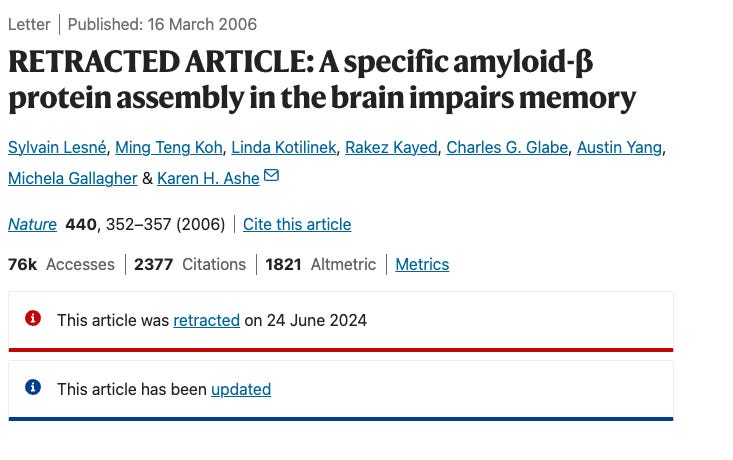
Not an isolated incident. Unfortunately, the MAPC fiasco isn’t unique. Alzheimer’s research faced its own reckoning when a high-profile paper reinforcing the amyloid plaque theory was later found to contain fabricated data (Lesne et al., 2006). For years, billions flowed toward drugs targeting amyloid plaques—yet many of these approaches are only now being reconsidered as the therapeutics removing plaques show only minor if any actual efficacy. In fact, we reviewed this in an earlier post. Similarly, in cardiac regeneration, Dr. Piero Anversa’s celebrated research on adult stem cells repairing hearts unraveled, prompting dozens of retractions and wasted clinical trials.
From Andrew Wakefield’s vaccine-autism myth published in The Lancet (retracted after 12 years) to Anil Potti’s debunked “personalized” cancer-genomics approach at Duke, history repeatedly shows that extraordinary claims require rigorous verification. Hype can overshadow healthy skepticism, but robust replication remains essential.

AI Watchdogs. One promising force speeding up modern retractions is the growing use of AI-powered software to detect suspicious images in scientific manuscripts. While the MAPC paper’s downfall resulted mainly from human whistleblowers—and the passage of time—an increasing number of retractions today are triggered by automated checks that spot duplicated or manipulated figures. Tools like Proofig, ImageTwin, and custom algorithms deployed by journals now rapidly scan manuscripts. These AI systems compare images across vast databases, quickly detecting suspicious patterns—such as identical bands in a Western blot or repeated microscopy panels—far more efficiently than human reviewers alone.
In recent years, AI-driven screening has contributed significantly to an increased rate of retractions, as journals can swiftly identify problematic data or respond decisively to concerns raised on online forums like PubPeer. The synergy between advanced image-detection AI and public post-publication peer review creates a sharper, faster feedback loop. When an anomaly is flagged, editors can immediately request raw data or launch investigations, rather than letting potential misconduct slip through for years. But it’s worth digging deeper. Why is our system creating this fraud in the first place?
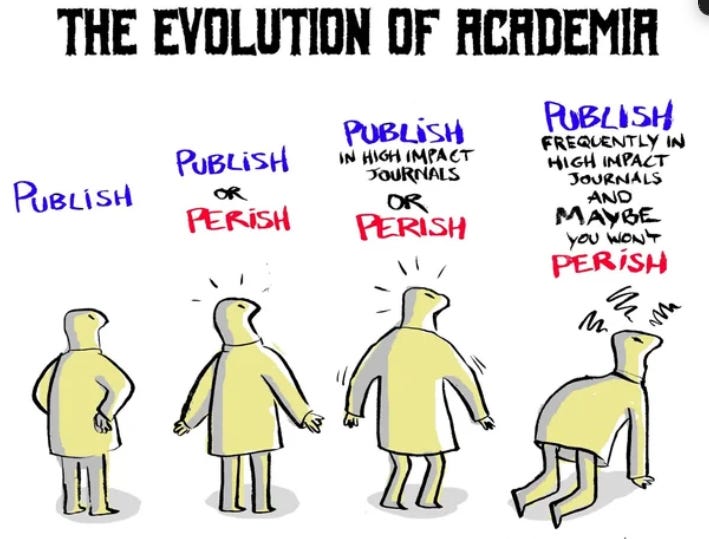
Publish or Perish. A major driver of scientific misconduct is the intense pressure researchers face to publish—not just frequently, but specifically in high-impact journals. In academia, the success of graduate students and principal investigators is often measured by the number of articles they produce, the prestige of the journals they publish in, and how frequently their work is cited. These metrics, tracked on platforms like Google Scholar and PubMed, significantly influence career opportunities, grants, awards, and faculty positions. However, this environment can incentivize scientific misconduct.
Negative or reproduced results—both valuable scientific outcomes—are often considered insufficiently “exciting” for high-impact journals, pushing researchers to exaggerate or selectively report findings. The relentless pursuit of quantity over quality can flood the literature with lower-quality research published in less rigorous journals, making it increasingly difficult to detect genuine fraud. As publication volumes rise, thorough peer scrutiny becomes challenging, ultimately undermining confidence in published science.
Assigning blame to individual researchers won't fix the systemic nature of these issues. Yet the pressure to produce novel, headline-worthy results remains one of science’s starkest contradictions. Although "negative" results—those disproving a hypothesis—are scientifically essential, they're far less likely to reach publication. You might argue that the desire for exciting findings shouldn't override scientific ethics, but unfortunately, individual researchers are only part of a much larger system. When publication quantity and novelty outweigh rigor and reproducibility, even research that isn't explicitly fraudulent can weaken the overall reliability of the scientific record.
Final thoughts. Scientific breakthroughs are tremendously exciting and, in certain cases, can revolutionize medicine. But the moment we stop demanding transparency, replication, and data integrity, we open the door to wasted resources, eroded trust, and years spent following dead ends.
The good news is that the scientific process, imperfect as it may be, does eventually correct itself. The MAPC paper’s downfall, 22 years later, is proof that—even if it requires painstaking effort—truth tends to resurface. For all the heartbreak and frustration, this saga stands as a stark reminder: be skeptical, be methodical, and be prepared to challenge the status quo. Ultimately, we build a stronger foundation for progress when we follow the rigorous, iterative approach that science demands.
Additional example:
Paolo Macchiarini was a thoracic surgeon at the Karolinska University Hospital in Sweden, before his career abruptly terminated due to gross scientific and medical misconduct. In 2011 he was acclaimed as the first surgeon to perform a trachea transplant thanks to a revolutionary synthetic implant coated with stem cells. However, none of Macchiarini´s extraordinary claims were backed by any scientific evidence, which cost the lives of seven of the eight patients that had undergone the operation before the fraud was eventually uncovered. Multiple papers by Macchiarini were retracted, motivated by not having obtained the patients’ consent to the treatment, not backed up by sufficient pre-clinical data, and the doctor was eventually convicted in Sweden for the bodily harm caused to the patients.
Support:
These newsletters take a significant amount of effort to put together and are totally for the benefit of the reader. If you find these explorations valuable, there are multiple ways to show your support:
Engage: Like or comment on posts to join the conversation.
Subscribe: Never miss an update by subscribing to the Substack.
Share: Help spread the word by sharing posts with friends directly or on social media.
References:
Jiang Y., Jahagirda B., Reinhardt L., Schwartz R., Keene C., Ortiz-Gonzalez X., Reyes M., Lenvik T., Lund T., Blackstad M., Du J., Aldrich S., Lisberg A., Low W., Largaespada D., Verfaillie C., 2002. Pluripotency of Mesenchymal Stem Cells Derived from Adult Marrow. Nature, 418, pp. 41-49.
Thomson, J.A., Itskovitz-Eldor, J., Shapiro, S.S., Waknitz, M.A., Swiergiel, J.J., Marshall, V.S. and Jones, J.M., 1998. Embryonic stem cell lines derived from human blastocysts. science, 282(5391), pp.1145-1147.
Lesne S., Koh M., Kotilinek L., Kayed R., Glabe C., Yang A., Gallagher M., Ashe K., 2006. A specific amyloid-B protein assembly in the brain impairs memory. Nature, 440, pp. 352-357.
https://pubpeer.com/publications/DF95522E3585E37663CAD1972E70BD#
(sources: https://www.thelancet.com/journals/lancet/article/PIIS0140-6736(18)31484-3/fulltext ; https://web.archive.org/web/20231203113729/https://www.theguardian.com/world/2022/jun/16/sweden-surgeon-convicted-of-bodily-harm-over-synthetic-trachea-transplants
Truth will always prevail - Bernie Madoff
"Yet, as your friendly neighborhood skeptic might point out: this is how science, in the long run, self-corrects.”
Science does self-correct, but it didn’t correct itself in that case because the 2002 paper wasn’t science. It was fraud. That episode is more proof—as is the history of the last five years—of why suppressing unpopular dissent is so dangerous and so not-science: When The Science™ can’t be questioned, truth loses and lies win. When reality, honesty, and integrity form the foundation of inquiry (or of any human endeavor), then the long arc of science will bend toward truth. But not otherwise. “When I disagree with a rational man, I let reality be our final arbiter; if I am right, he will learn; if I am wrong, I will; one of us will win, but both will profit.”
As for the pressure to publish that researchers face, I divide the blame equally between the researchers’ mindless grubbing at the public trough and the government’s eagerness to keep the trough filled. The government’s motives are clear enough: to self-perpetuate and to be able to point to the work of “experts” and “researchers” that support its agenda. Even laymen know that 99.9% of scientists agree with who’s funding them. As for what scientists get by selling out, I’m less clear. I don’t understand the range-of-the-minute thinking it takes to abandon honesty anyway, but especially not in science. Macchiarini murdered people because…? Because he wanted to be famous? Get more grants? And when his lies were inevitably exposed, then what? He’s a sociopath and a hack and if he’s not doing life in prison then Sweden needs to have a national conversation about how it values human life.
To an outsider it looks like the major driver is a profound lack of integrity among scientists, who have allowed themselves to devolve into technicians, not scientists in any honorable sense. Nothing open to human choice is inevitable, though, including discarding real science by chasing grant money. In fact, you’d think that any institution would want to be able to point to its integrity as the feature distinguishing it from the rest of the field. The main reason nothing changes is because no one cares enough to change himself.