

Update to the previous article: LK-99: the real-life unobtainium?
In a previous post, we delved into the exciting claims surrounding LK-99, a material touted as the world's first room-temperature superconductor. The scientific community has been abuzz with anticipation, eager to validate these groundbreaking claims. As always, science is a dynamic field, and new findings have emerged that we believe are crucial to share with you.
Two recent studies have cast significant doubt on the room-temperature superconducting properties of LK-99:
"Comment on 'The First Room-Temperature Ambient-Pressure Superconductor'": This study raised concerns about the methodology of the initial LK-99 research. The authors synthesized LK-99 following the original protocol but did not observe any signs of superconductivity. They also pointed out potential issues with the original study's methodology.
"Absence of superconductivity in LK-99 at ambient conditions": This paper further challenges the superconducting claims. The researchers, after synthesizing LK-99, did not find any evidence of it being a superconductor at room temperature. Their computational analysis also did not support the claim of bulk superconductivity in LK-99.
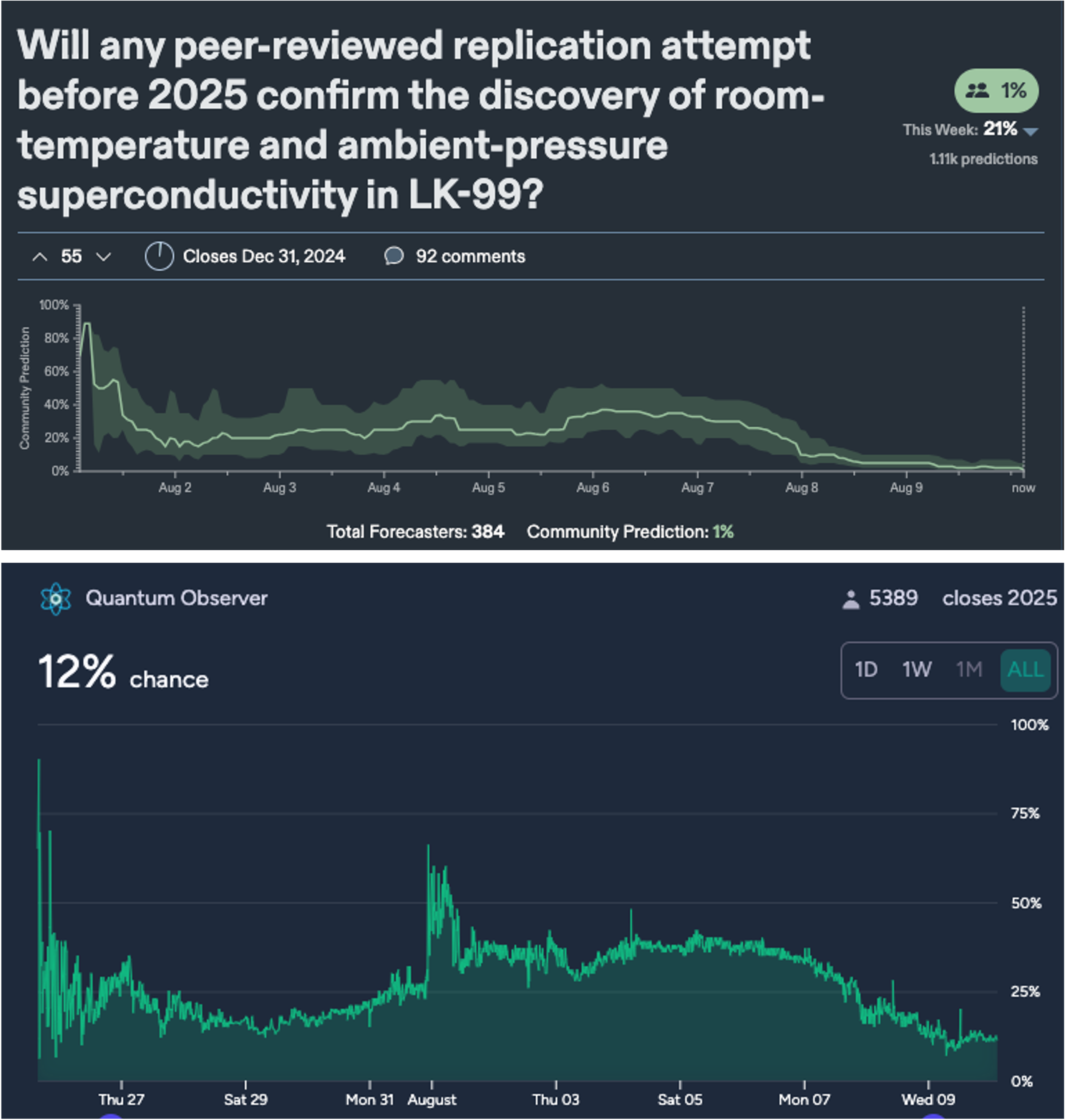
These recent findings make it far less likely that LK-99 possesses room-temperature superconducting properties as initially claimed. This assessment is reflected in prediction markets (Figure 1) that now believe it is far less likely LK-99 superconductivity will be reproduced in a peer-reviewed publication before 2025. For context, prediction markets are platforms where individuals can place bets on the outcomes of future events. In the previous post, these markets estimated a 31-38% probability; now, these odds have shifted down to between 1-12%.
While this might be disappointing to some (particularly the Na'vi of Pandora and everyone dreaming of hoverboards), it's essential to remember that science is a journey of discovery. Each study, whether confirming or refuting previous claims, adds to our collective understanding and brings us closer to the truth. Furthermore, this entire saga was quite amazing from the perspective of a jaded academic. Over these past few weeks, researchers both within and outside academia swarmed on this new potential new discovery. They sought to replicate the findings independently and shared their information at each step in various forums, particularly on X (previously known as Twitter) and arXiv (a preprint platform). This was a shining example of how the scientific process can work effectively.
I will continue to monitor developments around LK-99 and keep you updated. However, the excitement in this story is likely to end here. In the meantime, I appreciate your trust and engagement as we navigate the ever-evolving landscape of scientific progress.
Stay curious!

References:
Guo, K., Li, Y. and Jia, S., 2023. Ferromagnetic half levitation of LK-99-like synthetic samples. arXiv preprint arXiv:2308.03110.
Kumar, K., Karn, N.K., Kumar, Y. and Awana, V.P.S., 2023. Absence of superconductivity in LK-99 at ambient conditions. arXiv preprint arXiv:2308.03544.
👌
Disappointing outcome (for now), but as you say it's all about the slow and steady progress and where this might lead.
I want to kill myself (in a video game). After the excitement of the last article that covered this topic, I guess I'll never achieve flight as effortlessly as I hoped.