

Superconductors are materials that can conduct electricity with zero resistance. These materials are critical components of technologies like MRI machines, particle accelerators, and magnetic levitating trains. However, their use is extremely limited (and expensive) because they only work in extreme conditions, e.g., temperatures near absolute zero.
Recently, scientists claimed a breakthrough - the discovery of the world's first room-temperature superconductor. In a preprint paper, researchers from South Korea reported creating a material they call LK-99 using common elements like Lead and Copper (Lee, 2023). They say LK-99 can superconduct at room temperature and normal pressure.
If proven true, this would enable revolutionary new applications by making superconductivity practical under everyday conditions. However, the scientific community is divided, with many expressing skepticism about such a significant advance.
In this post, I’ll walk through what was discovered, explain why you should care, assess the probability the claims are valid, and explore what comes next in this unfolding scientific saga.
The claim:
Scientists from the Quantum Energy Research Centre in Seoul, Korea, have discovered a new material they have named LK-99. They claim this material can conduct electricity without any resistance, even at room temperature and normal pressure. This is a significant breakthrough because most superconductors, materials that can conduct electricity without resistance, usually need to be extremely cold to work. The secret of LK-99 lies in a subtle but crucial change in its structure. By swapping one type of atom for another, the researchers have created special areas within the material that allow electricity to flow freely. This atomic swap alters the electronic properties of the material, making LK-99 a potential superconductor for everyday conditions. The ability to manipulate a material's properties at the atomic level to achieve superconductivity at room temperature could open up new avenues in material science.
Why you may care:
To truly grasp the significance of LK-99's discovery, let's take a detour through the world of Hollywood. In the blockbuster film 'Avatar', humans voyage to a distant planet named 'Pandora' to mine a rare, fictional mineral known as 'unobtainium'. This mineral is priceless due to its ability to act as a room-temperature superconductor. The plot thickens as the pursuit of this mineral results in the tragic genocide of the indigenous blue aliens. Now, imagine if we had our own 'unobtainium' here on Earth. That's what the discovery of LK-99 could mean for us. The discovery (if true) of this material has the potential to revolutionize technology and energy use, from making our electronic devices more efficient to potentially transforming public transportation systems. And the best part? No intergalactic travel is required!
Also, I would be remiss if I forgot to mention the potential for hoverboards!

Ok, but is this real? Let’s assess the evidence:
Like any good detective story, science is all about evidence, and the researchers behind LK-99 have certainly provided some of it. However, extraordinary claims require extraordinary evidence. Let’s look at what could support or go against.
Evidence for:
Detailed Findings: The researchers have provided data and detailed findings about LK-99's properties, suggesting they've conducted thorough experiments.
Scientific Track Record: The scientists involved have made significant contributions to their field in the past, lending some credibility to their current claims.
Evidence against:
Rogue author: it appears the preprint was published without the consent of all the authors.
Peer Review: The research on LK-99 is currently in preprint form, meaning it hasn't undergone the rigorous peer review process yet. This process is crucial in ensuring that the study's methodology and conclusions are robust.
Need for Replication: Even if the study passes peer review, its results must be replicated by other scientists. Replication ensures that findings are consistent and not just a one-off occurrence.
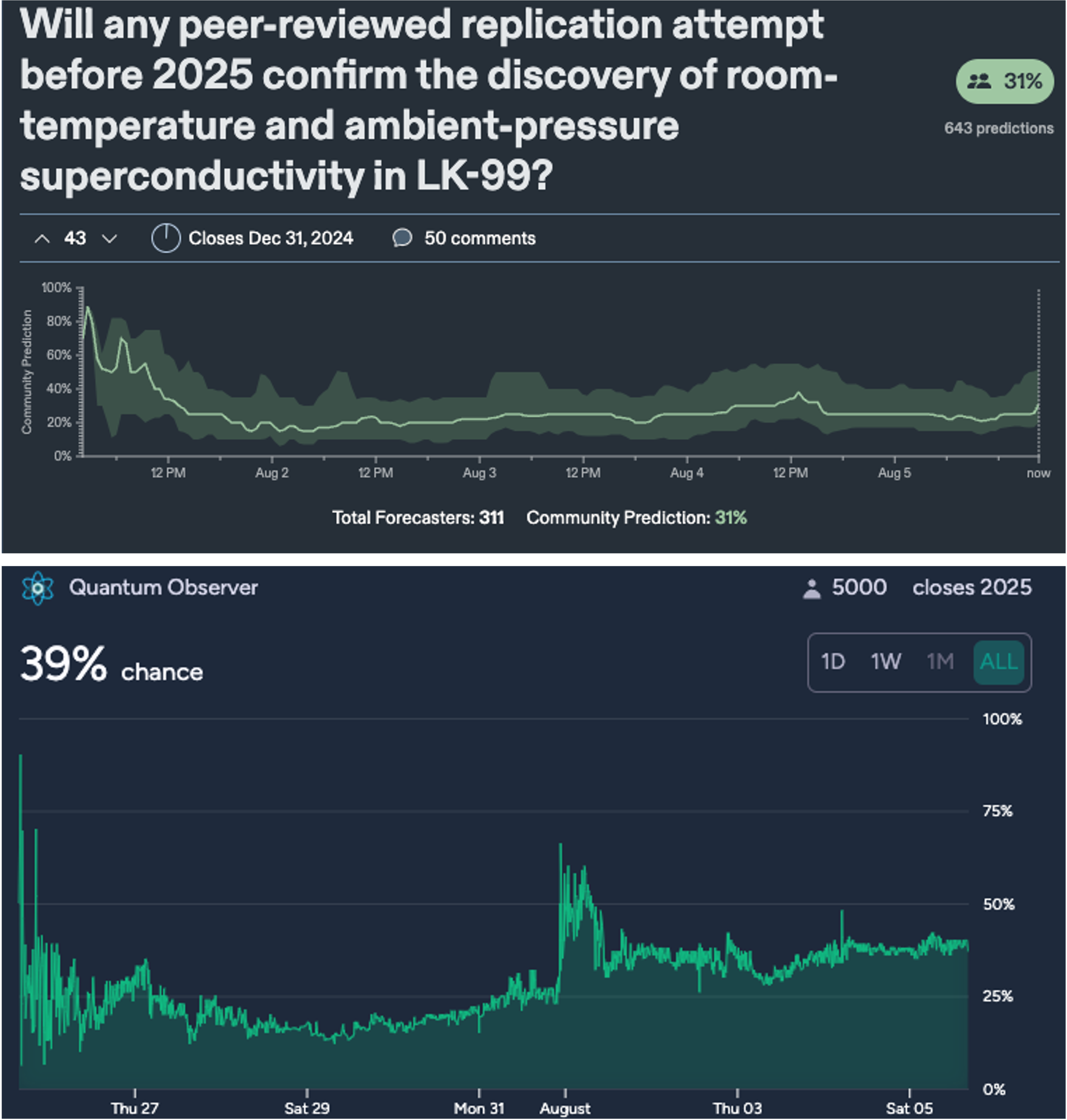
Prediction Markets: Prediction markets currently give a 31% to 39% chance of LK-99's superconductivity being replicated by 2025 (Figure 1). This reflects some skepticism in the scientific community.
Other Evidence:
Research Source: The researchers behind LK-99 come from the Quantum Energy Research Centre in Seoul, Korea, which seems like a reputable institution. However, I have had a difficult time confirming this, so I don’t think I can quite add it to the ‘Evidence for’ category.
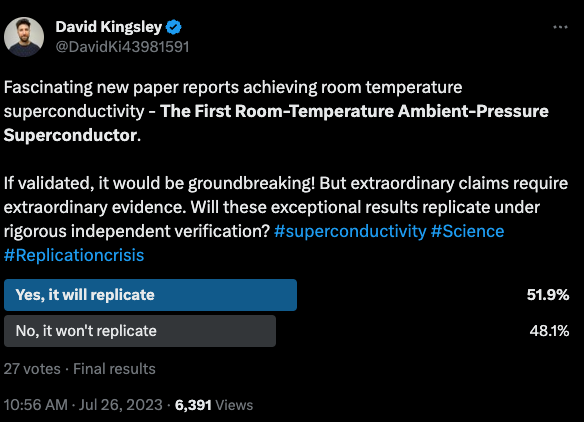
Public Opinion: A Twitter poll I conducted showed 52% believing in replication. However, this is based on a smaller sample and likely reflects general public enthusiasm more than scientific consensus (Figure 2).
Ongoing Research: The researchers have hinted at more results and discussions on LK-99 in the future, indicating that their work is still in progress and not yet conclusive.
Based on the detailed assessments above, there appears to be twice as much evidence that cuts against LK-99 as a viable room-temperature superconductor than evidence supporting that claim. However, even a 30 percent chance would be worth chasing down. That said, it's probably a good idea to hold off on any 'Avatar'-like fantasies until more information becomes available.
What comes next:
Imagine a race where the finish line is a scientific breakthrough. That's exactly what's happening right now with LK-99. Scientists around the world are in a mad dash to confirm whether this new material really is a superconductor that works at room temperature.
So far, the race has had its share of twists and turns. Teams from India and China claim to have managed to create LK-99, but they didn't see the signs they were expecting that would confirm it's a superconductor. This would indicate they either incorrectly produced the material or it lacks superconductor abilities. However, another team in China found some promising signs, but only at temperatures much colder than your average winter day (Garisto, 2023).
Meanwhile, a separate study has given the LK-99 supporters some hope. They found some features in LK-99 that are often seen in other superconductors, suggesting that the claims about LK-99 might not be so far-fetched after all (Griffin, 2023).
So, what's the next step in this scientific race? More teams will join in, each trying to replicate the original results. It's a bit like a game of 'telephone', where the message (or in this case, the experiment) gets passed along to see if it stays the same. This process is crucial to ensure that the claims about LK-99 hold up under scrutiny.
While the race is on, it's important to remember that in science, slow and steady often wins the day. So, while we wait for the results to come in, let's keep our fingers crossed that LK-99 turns out to be the scientific treasure it promises to be.
References:
Garisto, D. 2023. Claimed superconductor LK-99 is an online sensation - but replication efforts fall short. Nature.
Griffin, S.M., 2023. Origin of correlated isolated flat bands in copper-substituted lead phosphate apatite. arXiv preprint arXiv:2307.16892.
Lee, S., Kim, J.H. and Kwon, Y.W., 2023. The Firs Room-Temperature Ambient-Pressure Superconductor. arXiv preprint arXiv:2307.12008.
Great write-up, David. Andrew Cote on XBird calls it a diamagnetic semiconductor. Alex Kaplan tweets like crazy about it, too. Mostly, that it doesn't work. Thing is, one day it will. From a pragmatic POV, LK-99 can't be it because it is too big of a discovery to be shared freely with the world.
One day we'll have Qlev vehicles along with everything that comes with room temp SCs. It is going to change the world as we know it.
I teamed up with a professional car designer to create Qlev pods (S-zer0, JCAB) for my speculative fiction novel Spherean, e.g. https://alexanderipfelkofer.substack.com/p/gain-labs-presents-the-s-zer0 maybe you find it interesting.
I think this was a very fun and refreshing article to read. I'm taking credit for the Korean discoveries because I am half Korean and that's how our achievement in society works 😏. Just kidding, but, seeing more articles like this would be awesome. Nothing too serious, just fun and up to date articles that show a clear view of how something in the scientific community works. Like reading about what evidence is promising vs what isn't and conclusions that can be drawn from it. Just scientific perspectives on topics in general.