


Happy Sunday night, Readers. Let’s be relentless this week!
Welcome to the first BioWire of 2025— this year is already shaping up to be full of rapid advancements in biotechnology, artificial intelligence, and their intersection. I fully expect our minds to be blown by what we will be seeing throughout the year. And this community is where you can keep up with all of this. So if you are not subscribed, consider doing so.
Before we start with this week’s updates, I want to take a moment to celebrate an exciting milestone: we’ve hit (and surpassed) 1,000 subscribers! This growth has been nothing short of incredible. Just last month, we celebrated crossing the 500-subscriber mark, and now we’ve doubled it. This shows the appetite for Biotechnology and AI on Substack; each of you making up this community and your enthusiasm fuels this journey. I couldn’t be more grateful to be a part of this with you all.
This milestone is also a reminder of the responsibility I have to you, my readers. I take this role with absolute reverence and will always strive to bring you the most accurate, thoughtful insights while keeping my own biases in check.
With that said, let’s dive into the latest updates!

Here is the news we will review this week:
Aerobic Exercise Produces Weightloss Results and That Increase With Intensity and Duration
Live Birth Achieved with Novel IVF Procedure that Matures Eggs Outside the Body
Heritable Polygenic Editing is on the Horizon - What Will That Mean?
OpenAI has created an AI model for longevity science
Aerobic Exercise Produces Weightloss Results and That Increase With Intensity and Duration

It seems like every week, we’re discussing obesity in some capacity—and this week is no exception. Obesity remains a significant predictor of all-cause mortality, making proper weight management a critical public health goal. We’ve talked about medical interventions like GLP-1 receptor agonists, but what about good old-fashioned exercise? How much exercise is really needed to lose weight, and what are the benefits of moderate versus intense exercise?
Lucky for us, a new systematic review and dose-response meta-analysis published in JAMA Network Open answers these questions and more (Jayedi et al., 2025). This “study of studies” consolidates data from 116 randomized clinical trials involving 6,880 participants to explore how different levels of aerobic activity influence body weight, waist circumference, and body fat percentage.
Over intermediate time periods, the analysis found that every additional 30 minutes of aerobic exercise per week led to modest reductions in:
Body weight: 0.52 kg
Waist circumference: 0.56 cm
Body fat percentage: 0.37%
These effects were consistent across different intensities of aerobic exercise, with the most significant improvements observed at 300 minutes of weekly aerobic activity—culminating in 4.19 kg of weight loss and over 5 cm of reduced waist circumference.
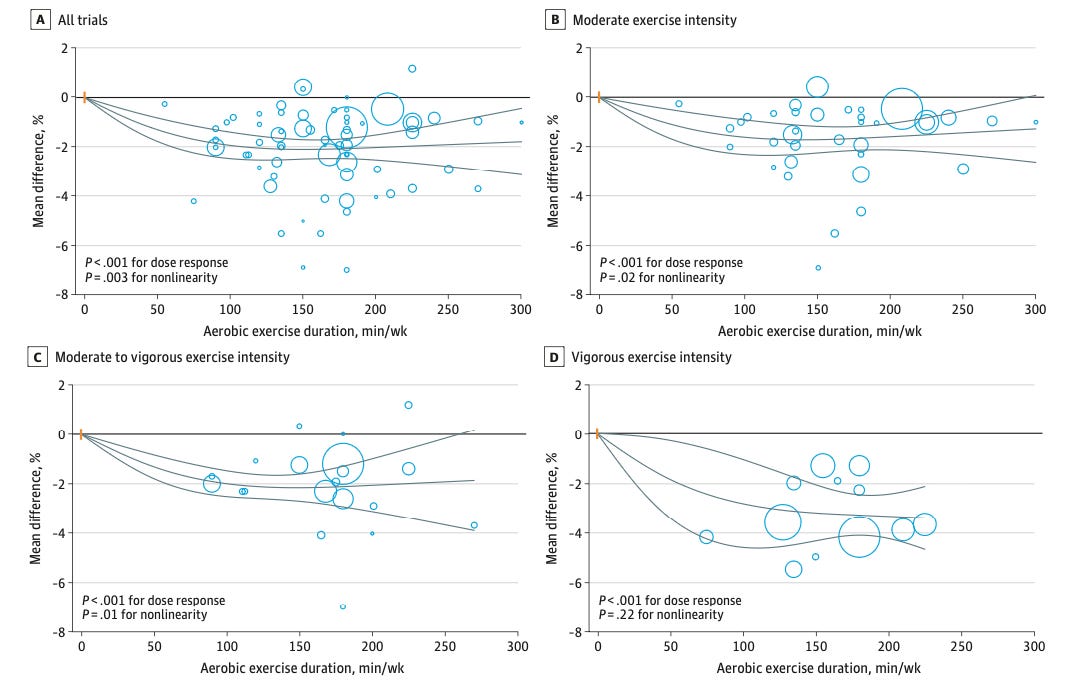
Perhaps not surprising, the study found a linear relationship between exercise duration and weight loss, confirming that “more is better”—at least up to a point. While 150 minutes per week marked the threshold for clinically meaningful reductions in waist circumference and body fat, the full benefits were seen at higher durations. However, the research also underscored the diminishing returns beyond this threshold and highlighted the importance of consistency and adherence for achieving sustained results. You’ve got to show up consistently each week to see the benefit.
Maybe this feels obvious. Few people will be shocked to hear that aerobic exercise leads to weight loss and improves body composition. But this meta-analysis reaffirms the critical role of exercise as a cornerstone of weight management. If weight loss drugs like GLP-1 receptor agonists work for you, by all means, go for it. But don’t skip the hard work.
Here’s the actionable takeaway: aim for at least 150 minutes of moderate to vigorous aerobic activity per week to see meaningful health benefits. And if you’re feeling ambitious, go beyond that for even greater results!
Live Birth Achieved with Novel IVF Procedure that Matures Eggs Outside the Body

In vitro fertilization (IVF) has been a frequent topic in this newsletter, exploring how emerging technologies are transforming every stage of the process—from AI-powered embryo selection to the potential of creating eggs from patient-derived stem cells. These innovations aim to alleviate the stress, pain, and complexity inherent in traditional IVF. Typically, IVF involves 10–14 days of hormonal stimulation of the potential mother to mature oocytes, followed by egg retrieval, fertilization, and embryo development to the blastocyst stage before implantation. This rigorous process often requires multiple cycles, making simplifications to any step, particularly oocyte maturation, a welcome advancement.
In an important advancement for reproductive medicine, Gameto announced the first live birth achieved using its Fertilo procedure, an innovative approach to in vitro fertilization that matures eggs outside the body. While live births resulting from in vitro maturation (IVM) of oocytes have been reported before, Gameto's Fertilo marks the first successful use of ovarian support cells (OSCs) derived from induced pluripotent stem cells (iPSCs) to achieve this milestone. Fertilo's end-to-end iPSC-based technology signals a significant step forward in assisted reproductive technology (ART).
The Fertilo procedure eliminates approximately 80% of the hormone injections required in conventional IVF, reducing the duration of treatment cycles from 10–14 days to just three. This gentler approach minimizes risks such as ovarian hyperstimulation syndrome (OHSS) and alleviates the physical and emotional strain on patients. By co-culturing immature eggs with proprietary OSCs, Fertilo replicates the natural ovarian environment to support egg maturation and improve embryo formation rates.
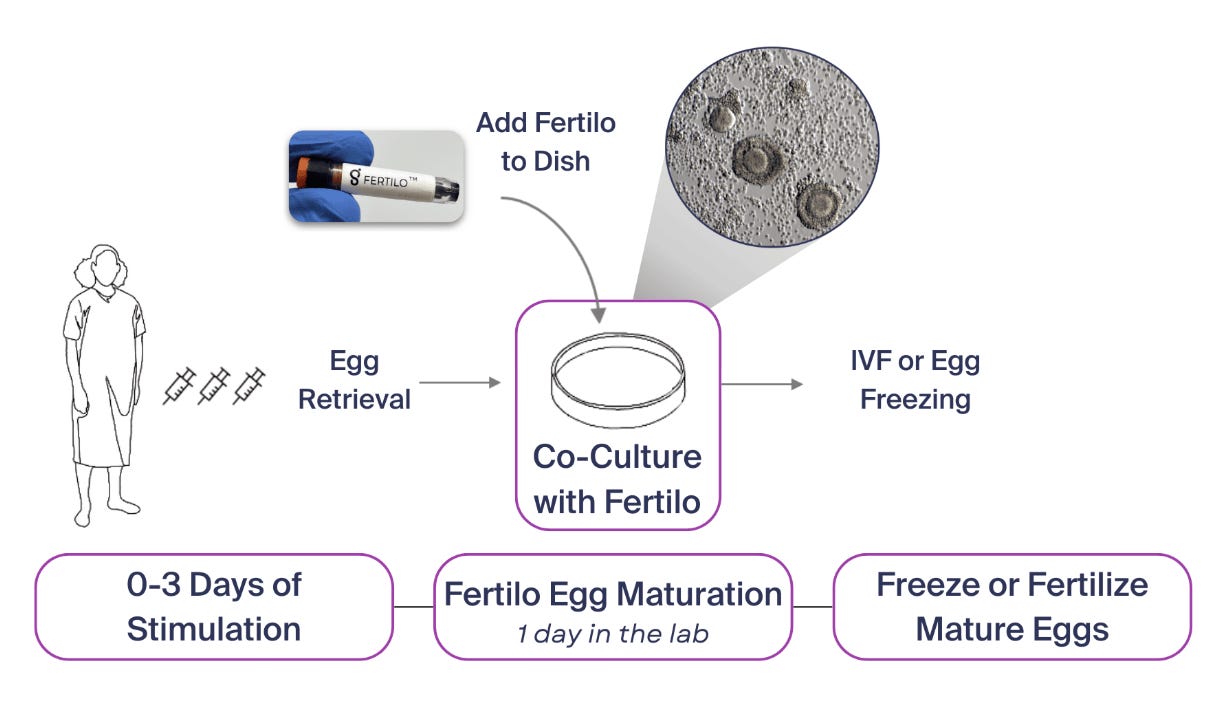
What sets Fertilo apart is its use of OSCs engineered to produce and respond to natural ovarian hormones, creating a supportive and efficient maturation process in vitro. This technology enables patients who cannot tolerate traditional IVF protocols—or prefer to avoid them—to access safer and more accessible fertility treatments. Fertilo not only maintains efficacy comparable to traditional IVF but also offers a shorter and less invasive pathway to conception.
While traditional IVM has shown variable success in the past, often limited by inconsistent results and lower embryo viability, Fertilo leverages the precision of iPSC technology to overcome these barriers (Piechota et al., 2023). This represents a significant leap in both the science and accessibility of ART. Gameto has already secured regulatory clearance for Fertilo in multiple global markets and is advancing toward Phase 3 trials in the U.S.
As Dr. Dina Radenkovic, Gameto's CEO, explained, “This milestone marks a turning point in reproductive health, providing a faster, safer, and more accessible solution for families.” The Fertilo procedure not only demonstrates the potential of iPSCs in advancing fertility treatments but also sets the stage for broader applications in women's health.
Heritable Polygenic Editing is on the Horizon - What Will That Mean?

For many biological traits, a single gene does not dictate a single function. Instead, features like height, intelligence, body composition, and suscepticibility to many diseases are influenced by the combined effects of many genes, making them polygenic in nature. In an interesting article published in Nature, researchers explore the potential of heritable polygenic editing (HPE) as a tool in genomic medicine (Visscher et al., 2025). Unlike traditional monogenic gene editing, which addresses single-gene disorders, HPE focuses on modifying multiple genetic variants associated with complex traits and diseases. This approach has the potential to dramatically reduce the prevalence of conditions such as coronary artery disease, Alzheimer’s disease, and type 2 diabetes by editing a relatively small number of key genomic loci.
The authors modeled the effects of editing up to ten key genetic variants associated with these diseases, demonstrating that such interventions could reduce lifetime risks dramatically—for example, slashing Alzheimer’s risk from 5% to 0.6% among edited genomes. However, the feasibility of HPE remains speculative, with current technology far from being able to perform the precise multiplex edits required. Nevertheless, advances in genome-wide association studies (GWAS) and improved genome-editing tools like CRISPR could bring this closer to reality within the next few decades.
The societal implications of HPE are a lot to unpack. This goes well beyond exacerbating societal inequalities. Perhaps the most interesting and worrying is pleiotropy—the phenomenon where genetic variants affect multiple traits—poses significant challenges. For instance, editing a variant to reduce disease risk could inadvertently increase susceptibility to another condition. These technologies will likely become available long before we sort through their implications.
The other elephant in the room is that HPE raises the obvious potential for a future of human enhancement. Beyond disease prevention, this technology could be used to alter traits like intelligence or physical ability. It’s important that we have these conversations early as the consequences will be immense.
OpenAI Enters Longevity Science with Protein Engineering Model

In our recent Top 5 Biotech Breakthroughs of 2024 article, we highlighted the impact of AI on drug discovery and protein engineering. Perhaps the most impactful of these applications was AlphaFold 3 from DeepMind winning a Nobel Prize in Chemistry for contributions to structural biology and drug discovery. These applications of generative AI in biology are potentially their most impactful. Building on this momentum, OpenAI has announced its first foray into biological data with a novel AI model designed for protein engineering. Dubbed GPT-4b micro, this specialized model was used to optimize the Yamanaka factors—proteins essential for reprogramming cells into induced pluripotent stem cells (iPSCs). This advancement not only enhances the efficiency of stem cell creation but also positions AI as a game-changer in longevity research.
The project was born from a collaboration with Retro Biosciences, a longevity-focused biotech company backed by OpenAI CEO Sam Altman, who invested $180 million in the venture. Retro is exploring ways to extend human lifespans by at least 10 years, with cell reprogramming at the core of their strategy. Despite its transformative potential, traditional cell reprogramming processes remain inefficient, with less than 1% of cells successfully completing the journey to iPSCs in lab settings. OpenAI’s model tackled this bottleneck by proposing modifications to the Yamanaka factors, achieving up to a 50-fold increase in efficiency, according to preliminary results.
OpenAI touts GPT-4b for is its ability to generate unconventional and effective protein designs. Unlike Google DeepMind’s AlphaFold, which predicts protein structures, GPT-4b micro was trained to suggest amino acid modifications that improve protein function. This capability is particularly valuable for proteins like the Yamanaka factors, which are floppy and lack defined structures, making them difficult to optimize through traditional approaches.
While the results are promising, questions remain about transparency and reproducibility. The data has yet to be published in peer-reviewed journals, leaving outside experts unable to verify the claims. Furthermore, the model itself is not publicly available, suggesting that this initiative serves more as a proof of concept than a ready-for-deployment product. Nevertheless, the implications are exciting. These collaborations demonstrate how AI can accelerate progress in fields as complex and impactful as longevity science. It’s a bold step forward, signaling that the age of AI-driven scientific discovery is here.
Support:
These newsletters take a significant amount of effort to put together and are totally for the benefit of the reader. If you find these explorations valuable, there are multiple ways to show your support:
Engage: Like or comment on posts to join the conversation.
Subscribe: Never miss an update by subscribing to the Substack.
Share: Help spread the word by sharing posts with friends directly or on social media.
References:
https://www.forbes.com/sites/alexyork/2024/12/16/this-next-generation-ivf-startup-facilitated-the-birth-of-a-baby-for-the-first-time/
https://www.technologyreview.com/2025/01/17/1110086/openai-has-created-an-ai-model-for-longevity-science/
Jayedi, A., Soltani, S., Emadi, A., Zargar, M.S. and Najafi, A., 2024. Aerobic Exercise and Weight Loss in Adults: A Systematic Review and Dose-Response Meta-Analysis. JAMA Network Open, 7(12), pp.e2452185-e2452185.
Piechota, S., Marchante, M., Giovannini, A., Paulsen, B., Potts, K.S., Rockwell, G., Aschenberger, C., Noblett, A.D., Figueroa, A.B., Sanchez, M. and Barrachina, F., 2023. Human-induced pluripotent stem cell-derived ovarian support cell co-culture improves oocyte maturation in vitro after abbreviated gonadotropin stimulation. Human Reproduction, 38(12), pp.2456-2469.
Visscher, P.M., Gyngell, C., Yengo, L. and Savulescu, J., 2025. Heritable polygenic editing: the next frontier in genomic medicine?. Nature, pp.1-9.
Congrats on your first 1,000 subscribers!
Congrats on the huge milestone, David. Phenomenal growth!!
(Wish I could say the same, haha.)
Great roundup as always.