

Happy Tuesday Morning, Readers. Let’s be relentless this week!
I will be completely honest with you all: I was glued to the news this weekend, as I’m sure many of you were. There was no helping it. The events Saturday surrounding the attempted assassination of a previous and likely future US president (at least according to our AI forecasting experiment) monopolized my attention. It’s also difficult to understate how chilling the imagery from this event was.
Occasionally there will be an event that rips us out of our personal bubbles and reminds us that we are part of a country together with hundreds of millions of others and still very much living through history. This was one such experience for me.
I began writing this newsletter particularly focused on the risks associated with the rapid development of AI. I fear that even in the best-case scenario, we are racing at breakneck speed towards a goal that will deprive us of nearly all purpose. And trust me, there are many ways in which this can go entirely wrong.
I believe some of the risks posed by AI can be mitigated through advancements in human intelligence and consciousness. But the truth is, many existential risks face humanity, especially as we rapidly develop new and more sophisticated technology. There is no real way that we can be prepared for what is to come over the next 10 to 20 years. But the world that we end up in will very much be determined by our ability to work together to face the significant challenges posed by it. That is to say, we have far more in common than we have different between us all.
Enough ranting. Let’s talk biotech! This week’s edition of BioWire will cover a number of interesting topics at the interface of biomedicine, biotechnology, and computational sciences:
Oral GLP-1 Products for Treating Obesity

GLP-1 drugs have gained popularity for weight loss, typically administered as weekly injections. Transforming this into a daily oral therapeutic is of high interest. Pfizer is currently advancing one such oral GLP-1 candidate, danuglipron, toward pivotal trials after earlier setbacks. The company discontinued a twice-daily version due to high discontinuation rates but is now focused on a once-daily, modified-release formulation, which showed promising pharmacokinetic data and a favorable safety profile. Pfizer plans to conduct dose-optimization studies in the second half of 2024 to inform registration-enabling studies. The move positions Pfizer to compete with AstraZeneca and Eli Lilly in the highly competitive obesity treatment market.
New Stem Cell Therapy Improves Insulin Production in Diabetics
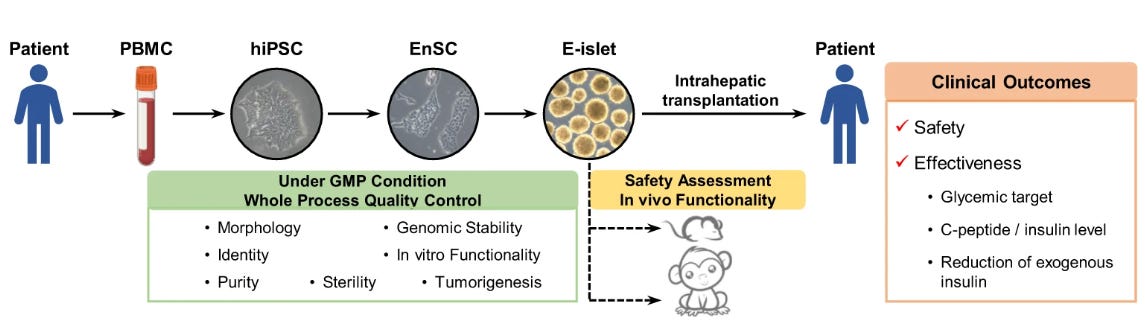
Induced pluripotent stem cells (iPSCs) are beginning to make a major impact in regenerative medicine by enabling the generation of patient-specific tissues. iPSCs are reprogrammed from adult cells and can differentiate into various cell types. A recent study reported in Nature showcases the first-in-human trial of autologous endoderm stem cell-derived islet tissue (E-islets) transplantation in a Type 2 diabetes patient (Wu et al, 2024). The patient showed significant improvements in glycemic control, reduced insulin dependence, and no adverse effects like tumor formation over a 27-month period. This pilot study highlights the potential of stem cell-derived islet tissues as a promising treatment for diabetes, offering an alternative to cadaveric islet transplantation with improved safety and efficacy.
Another AI Breakthrough in Protein Design
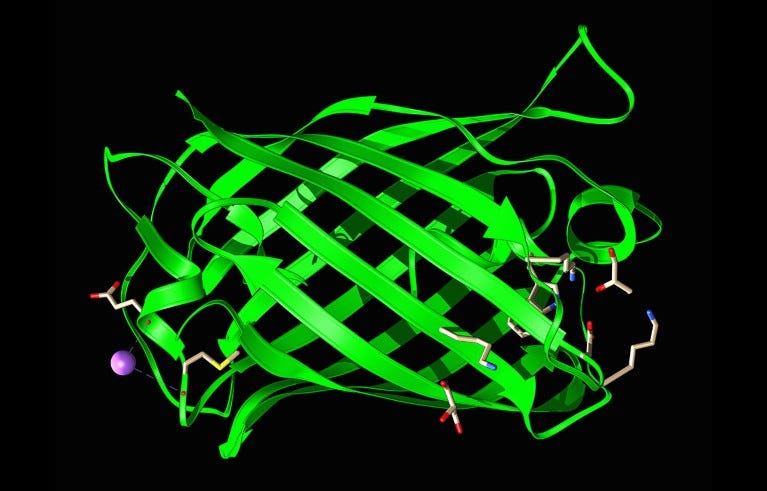
Ex-Meta scientists at EvolutionaryScale have developed a massive AI model, ESM3, for protein design, securing $142 million in funding (Callaway 2024). Trained on 2.7 billion protein sequences, the model creates new proteins, like brighter variants of green fluorescent proteins (GFP). ESM3's success underscores the potential of AI in biology, from drug development to sustainability. The model's unprecedented size and computational requirements mark a significant advancement, with its open-source version fostering broader research applications.
Advances in Decoding Brain Signals for Visual Reconstruction

There are major efforts to produce brain-machine-interfaces, a significant part of which requires decoding the signals of the brain. Another effort from researchers developed a new method called Predictive Attention Mechanism (PAM) to decode and reconstruct visual images from brain activity (Dado et al, 2024). This method uses advanced AI to focus on the most important brain signals. When tested, it could accurately recreate images people saw by analyzing their brain data, showing promise for improving brain-computer interfaces and potentially helping those with sensory impairments. The study highlights how certain brain areas are crucial for processing visual information.
Support:
These newsletters take a significant amount of effort to put together and are totally for the benefit of the reader. If you find these explorations valuable, there are multiple ways to show your support:
Engage: Like or comment on posts to join the conversation.
Subscribe: Never miss an update by subscribing to the Substack.
Share: Help spread the word by sharing posts with friends directly or on social media.
References:
Dado, T., Le, L., van Gerven, M., Gucluturk, Y. and Guclu, U., 2024. PAM: Predictive attention mechanism for neural decoding of visual perception. bioRxiv, pp.2024-06.
Callaway, E., Ex-Meta scientists debut gigantic AI protein design model. Nature.
Wu, J., Li, T., Guo, M., Ji, J., Meng, X., Fu, T., Nie, T., Wei, T., Zhou, Y., Dong, W. and Zhang, M., 2024. Treating a type 2 diabetic patient with impaired pancreatic islet function by personalized endoderm stem cell-derived islet tissue. Cell Discovery, 10(1), p.45.
https://investors.pfizer.com/Investors/News/news-details/2023/Pfizer-Provides-Update-on-GLP-1-RA-Clinical-Development-Program-for-Adults-with-Obesity-and-Type-2-Diabetes-Mellitus/default.aspx
https://www.businesswire.com/news/home/20240710971928/en/Pfizer-Advances-Development-of-Once-Daily-Formulation-of-Oral-GLP-1-Receptor-Agonist-Danuglipron
America will be the first to sell you something that actually gives you weight loss but it will most certainly shorten your life just as much if not more as obesity.
What I really like about this stack is that every single issue makes me go look up things I’ve never heard of before. Like “GLP-1 drugs.” I also read the ResearchGate paper about PAM and neural decoding, minus the part with math symbols. I know the authors’ intended audience is people in AI/computer science, not English majors, but the argot is really irritating and by the time I finished the paper I was in no mood to grant them or anyone else in the field the benefit of the doubt. They are *not* going to all that effort to help the handicapped.
Yes, I sound like the 21st Century equivalent of the people who sneered at the idea of flying machines. I get it. But if the last four years haven’t been Exhibit A for the basket case that is human morality, then what else has it been? The fact that the EvolutionaryScale scientists used to work for Meta, where their former co-workers are still busy deleting my complimentary comments about people’s cat pictures—or their AI is doing it for them—just makes it worse. So does the fact that the researchers spent just four sentences acknowledging (without really addressing) “concerns about mental privacy and the potential misuse of technology.” Considering what I know about how Meta views its users’ privacy, and considering what I know about the government’s involvement in social media (Murthy, anyone?), the fact that *for now* they’re relying on “full and constant subject cooperation” doesn’t help. And really, given Murthy’s thousands of pages of proof that Meta’s in bed with the intelligence services, the research its once and future scientists are doing should be setting off the world’s loudest warning sirens. Tech employees are in the dictionary under “fungible” for their ability to transition from Silicon Valley to government jobs and back.
The writers devote one line at the end of the paper to mentioning the technology’s use in *neuro* prosthetics. For a while I thought they were working on technology that could be applied to artificial limbs a paraplegic could control by thinking about it. The AI would “learn” the brain’s signals for “walk now” and make walking as automatic for a paraplegic as it is for anyone else. Instead, what I got out of the whole article is that as soon as they figure out how to reliably reproduce what someone sees, they’ll reverse-engineer that into their “brain-computer interfaces” to do exactly what they say it can’t do now: “reliably apply it to other subjects” and “reconstruct” internally-generated “imagery and dreams.” They want to pry into our brains.
Sure, maybe the research can “revolutionize their understanding of how complex information is processed and interpreted.” But so could asking the subject. And anyway, what the hell have biologists been doing sticking electrodes in monkey brains for the last hundred years? These guys have been trying to “revolutionize their understanding of how complex information is processed” for at least that long, so if they don’t know by now they either never will or they’re being disingenuous about how they're going to use that knowledge. Put me down for B. Too many tech billionaires and “globalists” are on record promoting “trans-humanism,” however they define it. Their real motive for wanting a window into people’s brains is malignant. Combine that with everything they outright promote about social credit, digital currency, and the literal criminalization of opinions (thought crimes) already practiced in Europe, and you have a techno-fascist’s wet dream.
The risks posed by AI can be mitigated only by advancements in morality. Leaving aside meteors and volcanoes, the risks facing humanity are almost 100% man-made. The enemy is us.