


Happy Monday night, Readers. As always, let’s be relentless!
This week’s BioWire will be brief—I’ve had a busy weekend. However, there were a few notable developments in the biotech community that I would be remiss not to share. In this edition, we highlight the significant advancements of AlphaFold 3, hearing restoration in a gene therapy trial, and a brief update on Neuralink. How will these breakthroughs shape the future of medicine?
AlphaFold 3: A major upgrade to the AI protein predictor.
In this Substack, we often discuss AI and its implications for biotechnology and humanity. Back in 2021, Google DeepMind released AlphaFold 2, providing scientists with a powerful tool to predict protein structures based on amino acid sequences. Protein structure, particularly its 3D shape, is crucial as it determines how molecules interact and bind. The development of these tools has the potential to usher in a renaissance of drug discovery. While groundbreaking, AlphaFold 2 still left significant room for improvement, which is where AlphaFold 3 comes in.
This past week saw the release of AlphaFold 3, which significantly enhances the accuracy of predicting structures of biomolecular complexes (Abramson et al, 2024). It can accurately model interactions involving proteins, nucleic acids, small molecules, ions, and modified residues. It shows a 50% performance improvement compared to existing models and can predict protein-ligand, protein-nucleic acid, and antibody-antigen interactions. AlphaFold 3 marks a substantial step forward in the field, offering a unified framework for high-accuracy biomolecular modeling. Previous versions of AlphaFold have significantly impacted the fields of drug discovery, and this version already shows tremendous promise in further facilitating this progress. Moreover, AlphaFold Server was launched, providing an open-source tool for accessing and utilizing AlphaFold 3. For a more detailed look, check out the YouTube video linked above!
Neuralink PRIME Study Advances Despite Initial Challenges
In previous issues, we have discussed Neuralink's PRIME Study, which is testing a brain-computer interface (BCI) implant. The device, called the Link, aims to help people with quadriplegia control digital devices with their minds. Noland Arbaugh, the first participant, received the implant over 100 days ago and can now control his laptop and play video games by thought alone. Previously, he relied on a mouth-held stylus. The Link has significantly improved his quality of life, allowing him to use devices independently and reconnect with the digital world. The study aims to refine the technology, enhance performance, and eventually enable control of robotic arms and wheelchairs.
However, this progress has not been without challenges. “In the weeks following the surgery, a number of threads retracted from the brain, resulting in a net decrease in the number of effective electrodes.” While reducing the overall function, the device appears to be functioning well. Arbaugh said, “I thought that the mouth stick was a lot better than BCI a month ago, when we compared them I saw that BCI was just as good if not better and it's still improving; the games I can play now are leaps and bounds better than previous ones. I’m beating my friends in games that as a quadriplegic I should not be beating them in.” We hope that this is just the beginning for him.
For a more in-depth look at Noland’s experience, check the video above.
Promising Results from Gene Therapy for Childhood Hearing Loss
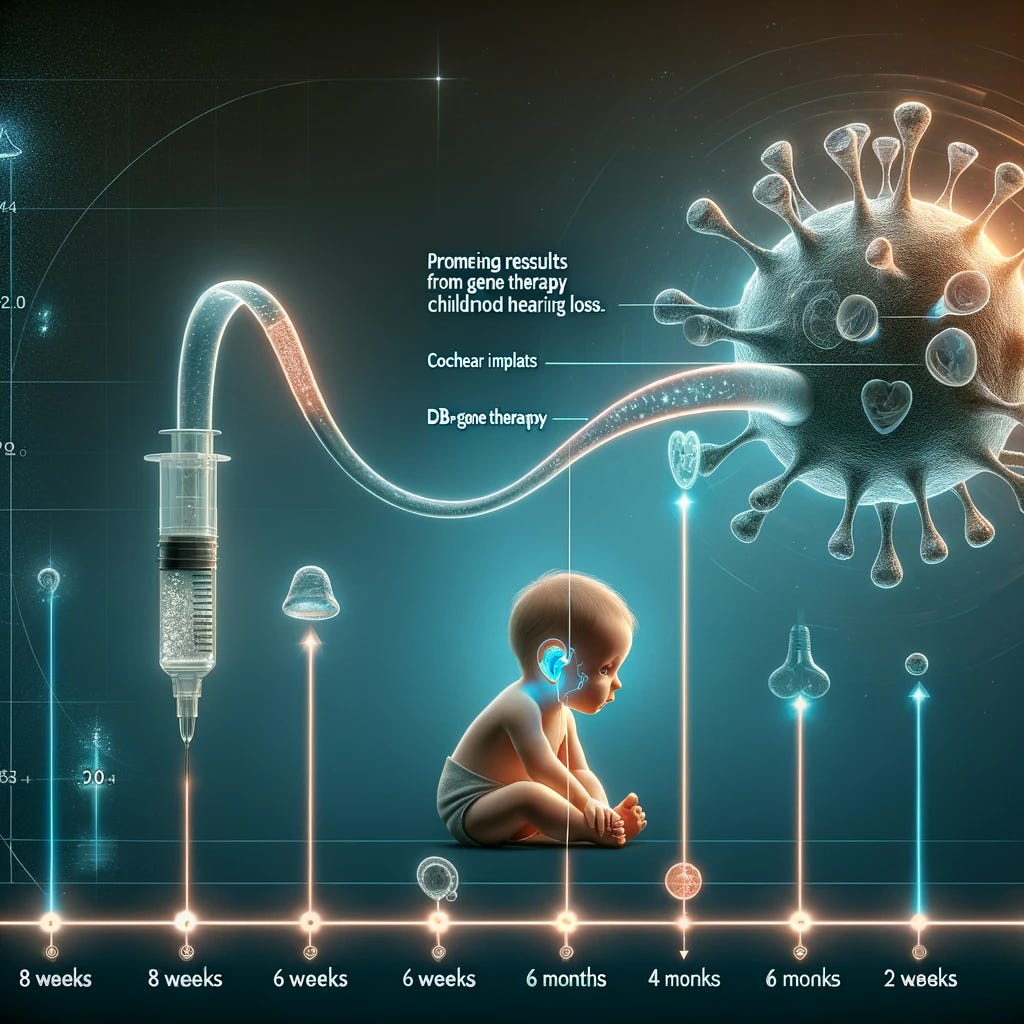
Regeneron is testing a gene therapy called DB-OTO to restore hearing in children with a specific genetic mutation. In a clinical trial, a baby began responding to sounds within weeks of receiving the treatment. By six months, she could destinguish sounds without her cochlear implant. This wasn’t an isolated incident; another child also showed similar improvements. The therapy uses an adeno-associated virus (AAV) to deliver the missing gene to ear cells, aiming to enable natural hearing. The trial shows promising results, with patients tolerating the treatment well and experiencing significant hearing improvements. Regeneron continues to enroll more patients to further assess the therapy's effectiveness. The full press release can be viewed here.
Support:
These newsletters take a significant amount of effort to put together and are totally for the benefit of the reader. If you find these explorations valuable, there are multiple ways to show your support:
Engage: Like or comment on posts to join the conversation.
Subscribe: Never miss an update by subscribing to the Substack.
Share: Help spread the word by sharing posts with friends directly or on social media.
References:
https://investor.regeneron.com/news-releases/news-release-details/latest-db-oto-results-show-dramatically-improved-hearing-normal
https://neuralink.com/blog/prime-study-progress-update-user-experience/
Abramson, J., Adler, J., Dunger, J., Evans, R., Green, T., Pritzel, A., Ronneberger, O., Willmore, L., Ballard, A.J., Bambrick, J. and Bodenstein, S.W., 2024. Accurate structure prediction of biomolecular interactions with AlphaFold 3. Nature, pp.1-3.
The Neuralink part is so cutting edge. I be it’s just a matter of time and red tape until they use the chip to talk to the exoskeleton units that exist to allow for people to use them using the chip.
Not trying to start a debate but it’s really sad that people (including the media) were really trying to say the whole test failed because of the hiccups. Why wouldn’t they be for private healthcare essentially providing amazing technology to increase the functionality within their lives. This technology is breathtaking.