

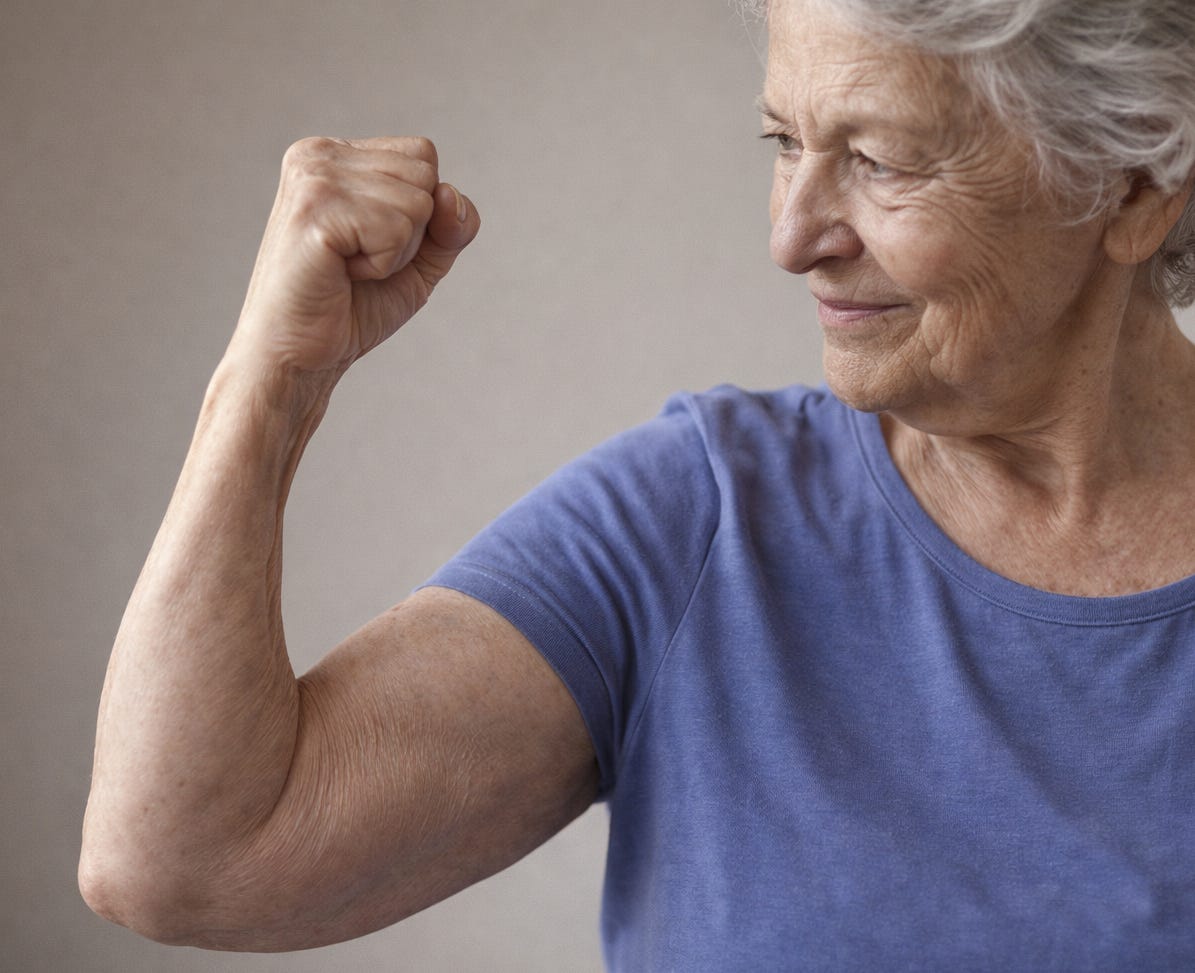
You’re at the doctor’s office getting a routine physical. They ask their normal list of questions about your eating and exercise habits. You mention the morning jogs, maybe some weekend cycling. They nod approvingly. What they aren’t trained to ask is how strong you are. A new study in JAMA Network Open suggests that strength is a critical indicator for longevity.
Researchers followed over 5,400 women aged 63 to 99 for nearly a decade. They measured two simple things: grip strength and the time it takes to stand up from a chair five times. Then they tracked who lived and who didn’t. The clear result was that stronger women lived longer; in the study, women in the highest quartile of grip strength had a 33% lower mortality risk compared to the weakest group, even after adjusting for age, smoking, comorbidities, and body weight (LaMonte, et al., 2026). Similarly, a 2022 meta-analysis of cohort studies reported that any muscle-strengthening activity was associated with lower risk of all-cause mortality and major non-communicable diseases (Momma, et al., 2022). But by how much?
First, if you enjoy these posts, consider subscribing and becoming a part of our growing community!
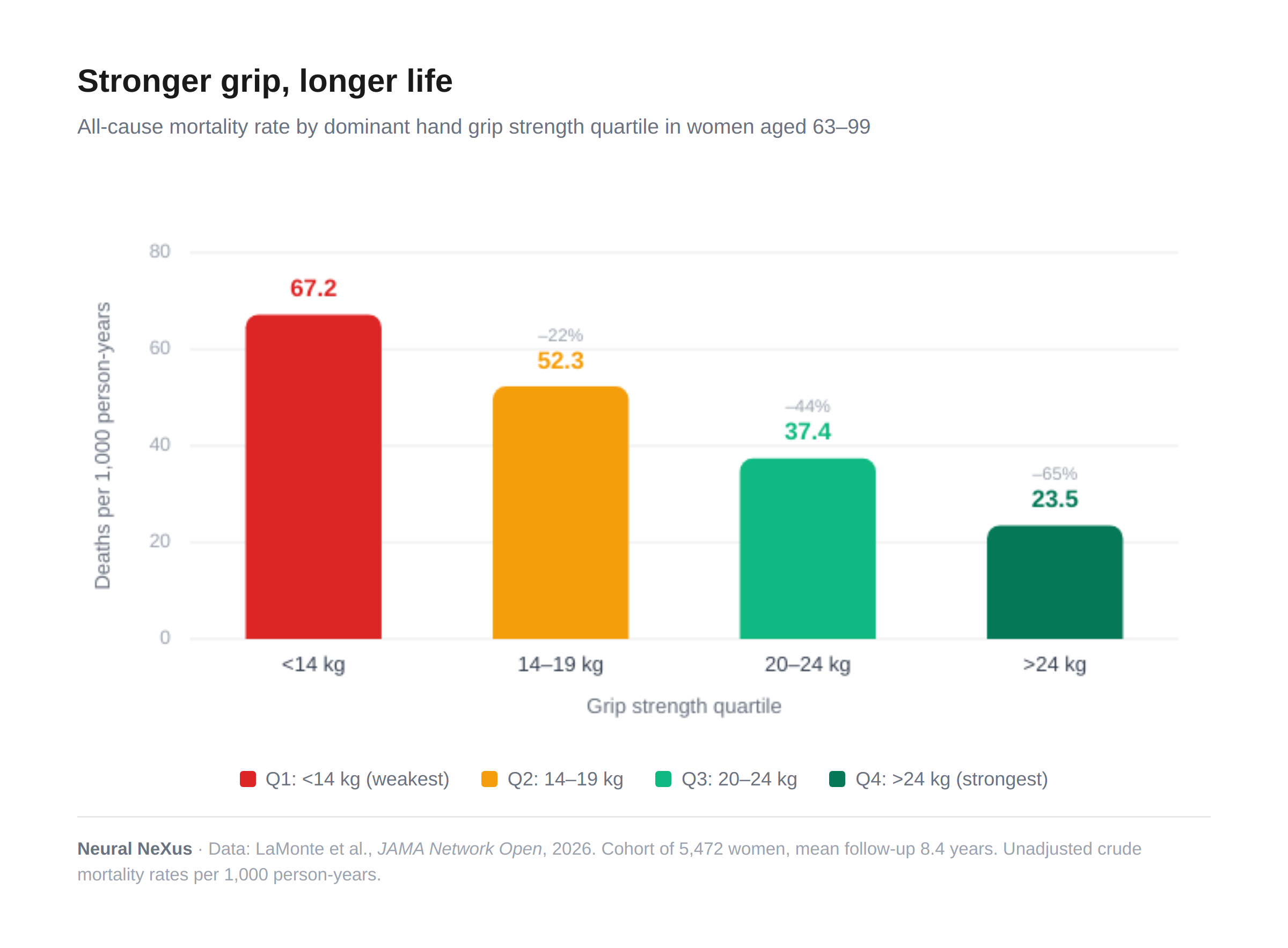
The mortality gradient is nearly threefold: 67.2 deaths per 1,000 person-years in the weakest quartile, dropping to 23.5 in the strongest. Normally researchers just use self-reported exercise. But in this study, they strapped accelerometers on every participant for a full week, capturing actual movement and sedentary time with objective precision. The survival advantage persisted through adjustment for moderate-to-vigorous physical activity, sedentary hours, walking speed, and C-reactive protein (LaMonte, et al., 2026).
The most provocative finding: grip strength was associated with lower mortality even in women who did not meet the recommended 150 minutes per week of aerobic activity. Read that again. Women who were essentially sedentary by guideline standards still lived longer if they were strong.
The two strength measures also told different stories. Grip strength barely budged when the researchers piled on health and clinical adjustments. Chair stand time attenuated almost to the null. The authors suggest chair stands may capture general health status and fatigability, while grip strength reflects something more fundamental about skeletal muscle output. Previous work supports this: muscle strength predicted mortality independent of muscle mass measured by imaging, suggesting that muscle quality matters more than quantity (Newman, et al., 2006).
The biology makes this plausible. Skeletal muscle is the body’s largest endocrine organ. Contracting muscle fibers release myokines that regulate inflammation, insulin sensitivity, and immune surveillance. Chronic inflammation accelerates loss of muscle mass and function through mitochondrial dysfunction and impaired excitation-contraction coupling (Ferrucci and Fabbri, 2018). The fact that CRP adjustment barely moved the association suggests the protective effect of strength operates through pathways beyond inflammation alone.
A caveat: this cohort is exclusively postmenopausal women from the Women’s Health Initiative. The findings may not generalize directly to men or younger populations.
By 2050, women over 75 will be the largest age subgroup in the United States. Most longevity guidance still emphasizes cardio. This study makes the case that strength is the more fundamental variable. It can be assessed in a clinic with a $30 dynamometer and a chair. The question is whether anyone will bother to measure it.
These newsletters take significant effort to put together and are totally for the reader’s benefit. If you find these explorations valuable, there are multiple ways to show your support:
Engage: Like or comment on posts to join the conversation.
Subscribe: Never miss an update by subscribing to the Substack.
Share: Help spread the word by sharing posts with friends directly or on social media.
References:
LaMonte, M.J., Hyde, E.T., Nguyen, S. et al. (2026) ‘Muscular Strength and Mortality in Women Aged 63 to 99 Years’, JAMA Network Open, 9(2), e2559367. doi: 10.1001/jamanetworkopen.2025.59367.
Newman, A.B., Kupelian, V., Visser, M. et al. (2006) ‘Strength, but not muscle mass, is associated with mortality in the Health, Aging and Body Composition study cohort’, The Journals of Gerontology Series A, 61(1), pp. 72-77. doi: 10.1093/gerona/61.1.72.
Momma, H., Kawakami, R., Honda, T. et al. (2022) ‘Muscle-strengthening activities are associated with lower risk and mortality in major non-communicable diseases: a systematic review and meta-analysis of cohort studies’, British Journal of Sports Medicine, 56(13), pp. 755-763. doi: 10.1136/bjsports-2021-105061.
As someone entering the peak ratbag years, I approve this message because cardio sucks. But I can do three sets of ten reps with black handgrips and sling 50 lb feedbags around like...well, not like they're nothing, but like the livestock won't get fed otherwise. Calcium score of 0 and BP 125/80. The chair thing? I get up five times every ten seconds to chase the cats. The thought of getting on the treadmill is unbearable, though, and besides: I can't find the remote for the DVD player.
Wow, that's interesting! Reason to keep up with the trapeze 💪