


Genetic engineering, that is, precise, intentional edits to DNA, has arrived. Its use is now ubiquitous in biotechnology research laboratories, powered by mature CRISPR toolchains, cheaper, faster genome sequencing, and a deeper understanding of how genes map onto function.
What does this mean practically?
We are now at the point where, for many applications, the question isn’t if we can make an edit, but who will fund it and perhaps as important, the underlying ethics. This BioWire Byte is a short case study: a cohort of horses were cloned from genetically engineered DNA to impart an advantage for muscle development to improve their muscle mass and speed for playing polo.
First, if you enjoy these updates, consider subscribing and becoming a part of our growing community!
Take a look at the image below. The four brown foals born late last year on an Argentine farm seem utterly ordinary. But these 10-month-olds represent a world first: they are genetically edited horses, created by Kheiron Biotech in Buenos Aires. Each is a cloned copy of a prize-winning polo mare (named Polo Pureza, or “Polo Purity”) with an important twist, a CRISPR-engineered DNA edit designed to boost their speed and muscle power. By using the CRISPR “genetic scissors” technique on the embryos, Kheiron’s scientists inserted a small mutation to dial down the horses’ myostatin gene, which normally acts as a brake on muscle growth. The concept is simple, less myostatin means more muscle fibers and more explosive acceleration, potentially transforming these horses into faster sprinters.

Four of the world’s first gene-edited foals, cloned from a champion polo mare and CRISPR-enhanced for muscle growth, at a farm in Argentina (2025). Photo credit.
Designing a Polo Pony with Cloning and CRISPR
Traditional cloning technology alone could only produce a genetic replica of the original champion horse. But what if we wanted to take it up a notch? Kheiron went a step further by adding a precision gene edit to the clone. While cloning creates an identical copy of the donor’s DNA, CRISPR functions as a kind of molecular scissors to cut and customize DNA. In this case, the team “cut” the myostatin gene, a known inhibitor of muscle development, effectively knocking it down to encourage greater muscle growth (I would like to volunteer myself for this as well).
The CRISPR edit is like an instant upgrade that selective breeding or random mutation might have taken generations to achieve. Gabriel Vichera, Kheiron’s scientific director, explains that CRISPR allowed them to make a precise change in the genome while keeping all the mare’s other superb traits intact. In other words, the foals have the exact DNA of a champion polo pony plus a tiny alteration that may give them extra muscle and speed. It’s a high-tech shortcut to what nature or breeding could have eventually produced – a horse with the genetic “muscle restrictor” removed.
Rationale for Myostatin Muscle Boost
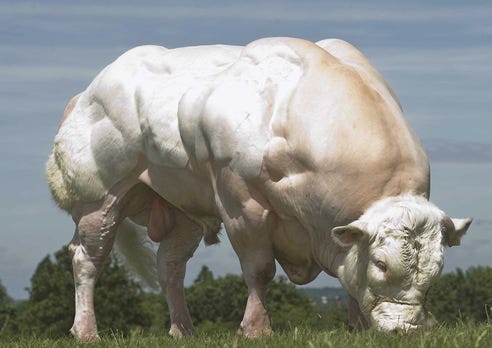
Why target the myostatin gene? Biologically, myostatin is a well-known muscle growth regulator, essentially the body’s “off switch” for muscle building. Animals (and people) with less myostatin tend to develop significantly more muscle. Reducing this inhibitor’s activity unleashes more muscle fiber growth, a fact borne out in multiple species. For example, certain cattle breeds (like the Belgian Blue) carry natural mutations in myostatin that produce “double-muscled” phenotype in bulls (see the figure below). In the dog world, there are whippet racing dogs with a myostatin mutation that have superior sprinting ability, and Chinese researchers famously used CRISPR to create extra-buff beagles by deleting the myostatin gene, resulting in dogs with double the normal muscle mass and greater strength. Even in humans, a few rare individuals born with disruptive myostatin mutations exhibit extraordinary muscular development. In fact, these myostatin isoforms have been speculated on famous bodybuilders and strength trainers.
This muscle-boosting pathway goes much further; it’s actively being explored for medical therapy. Biomedical teams have been testing myostatin-blocking treatments to help patients with muscle-wasting diseases like muscular dystrophy and age-related frailty, hoping to enhance muscle growth and strength. Further, myostatin-inhibition is even being explored in clinical studies in combination with weight loss therapies like semaglutide and tirzepatide to improve body composition. In short, a mountain of evidence across biology suggested that dialing down myostatin should make a horse more muscular and potentially faster over short distances. The edited foals are in many ways a living experiment to see if that promise holds true.
Interestingly, despite their high-tech pedigree, the CRISPR foals look and act like any other healthy young horses. Early reports indicate they are developing normally and showing no obvious differences aside from their expected muscly build (which at under a year old is not fully evident yet). This normal outward appearance underscores an important point: the edit made by Kheiron isn’t some exotic foreign gene or Frankensteinian add-on. It’s a subtle tweak to a gene all horses already have, akin to a naturally occurring variant. As one equine geneticist put it, the myostatin edit is simply “a gene that we know is present in healthy horses” – by performing a targeted edit in a clone, they are faithfully reproducing a trait that could have arisen by chance. That gives researchers confidence that these foals will suffer no ill effects; in theory, they are just like naturally muscley horses, only engineered deliberately and far more rapidly.
Polo Prospects and Controversy
However, in the world of polo, just because you can breed a super-horse doesn’t mean you can play one. Argentina is revered as the global capital of polo and has long embraced advanced reproductive tech, ranging from the widespread use of surrogate mares and embryo transfer to openly allowing cloned horses in competition. A note: many top Argentine polo ponies are clones of past champions, which is a practice accepted in polo, unlike in horse racing.
Yet the advent of gene-edited ponies has met pushback from the sport’s authorities. The Argentine Polo Association, the national governing body, has banned genetically edited (GE) horses from official tournaments, at least for now. Likewise, the Argentine Association of Polo Horse Breeders has urged caution, they plan to monitor these foals for several years before deciding whether to register them as legit polo ponies.
We continue to live through a time where reality is pressing against the bounds of science fiction. The birth of genetically engineered ponies is a landmark for biotechnology. It showcases the incredible possibilities of rewriting genomes for improvement rather than illness. All of this, and we haven’t even touched on the elephant in the room: how this same technology could be translated to humans.
These newsletters take significant effort to put together and are totally for the reader's benefit. If you find these explorations valuable, there are multiple ways to show your support:
Engage: Like or comment on posts to join the conversation.
Subscribe: Never miss an update by subscribing to the Substack.
Share: Help spread the word by sharing posts with friends directly or on social media.
References:
https://ir.unither.com/press-releases/2024/04-24-2024-140050479
https://www.kheiron-biotech.com/
https://www.reuters.com/world/americas/worlds-first-gene-edited-horses-are-shaking-up-genteel-sport-polo-2025-08-30/
"[A] mountain of evidence across biology suggested that dialing down myostatin should make a horse more muscular and potentially faster over short distances."
Is that something that can be finely tuned as though it's on a rheostat, or is it more of an on/off switch? With the beagles the gene was deleted entirely. Are the naturally-occurring mutations more of an impairment to the myostatin than a complete elimination of it, or does that vary with each case?
(For the record, normal bulls look deformed; that Belgian Blue doesn't even look like an animal. I've got a couple of good-sized beef cows, but he'd crush them.)
Super fascinating, this sort of stuff gets me excited about where we'll be with biotech by 2030