

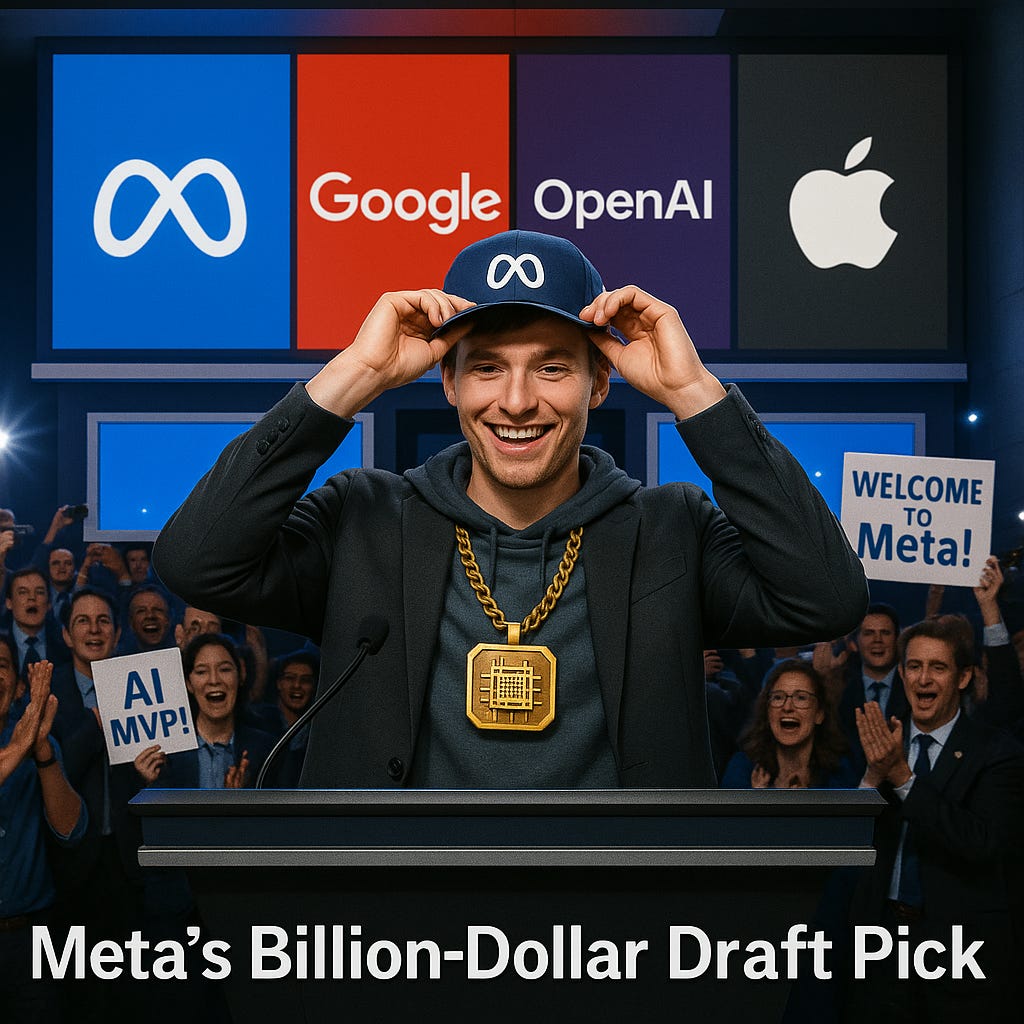
Meta, the parent company of Instagram, Facebook, and WhatsApp, is making aggressive moves to recruit the world’s top AI researchers, offering staggering compensation packages that reportedly reach ten figures (that’s over $1 billion for some individuals). The kicker? Many of these extraordinary offers aren’t even accepted. Clearly, Mark Zuckerberg views becoming a key player in the race toward artificial superintelligence as mission-critical for Meta. These garish and eye-popping bids underscore how fiercely tech giants are competing for elite AI talent and why Meta is willing to spend so lavishly to catch up.
First, if you enjoy these updates, consider subscribing and becoming a part of our growing community!
But first, exactly what is AI superintelligence, and why is it significant?
Superintelligence refers to AI systems that vastly surpass human capabilities across all cognitive domains. In narrow fields, we’ve already achieved this; consider games like Chess or Go, where AI can analyze moves so deeply that it guarantees victory every time. Now, imagine this capability gap between AI and humans extended across all cognitive tasks, including the creation of even more advanced AI itself. When AI can independently perform AI research and resulting self-improvement at rates matching or exceeding human ability, we enter the realm of recursive self-improvement. This means the AI’s own internal advancements will accelerate its capability to make further internal enhancements, leading to an exponential explosion of intelligence far beyond our current imagination. In other words, superintelligence.
What exactly is Meta’s vision for the AI superintelligence they are developing? I pulled this post from Meta’s website, posted July 31, 2025:
Personal Superintelligence
Over the last few months we have begun to see glimpses of our AI systems improving themselves. The improvement is slow for now, but undeniable. Developing superintelligence is now in sight.
It seems clear that in the coming years, AI will improve all our existing systems and enable the creation and discovery of new things that aren't imaginable today. But it is an open question what we will direct superintelligence towards.
In some ways this will be a new era for humanity, but in others it's just a continuation of historical trends. As recently as 200 years ago, 90% of people were farmers growing food to survive. Advances in technology have steadily freed much of humanity to focus less on subsistence and more on the pursuits we choose. At each step, people have used our newfound productivity to achieve more than was previously possible, pushing the frontiers of science and health, as well as spending more time on creativity, culture, relationships, and enjoying life.
I am extremely optimistic that superintelligence will help humanity accelerate our pace of progress. But perhaps even more important is that superintelligence has the potential to begin a new era of personal empowerment where people will have greater agency to improve the world in the directions they choose.
As profound as the abundance produced by AI may one day be, an even more meaningful impact on our lives will likely come from everyone having a personal superintelligence that helps you achieve your goals, create what you want to see in the world, experience any adventure, be a better friend to those you care about, and grow to become the person you aspire to be.
Meta's vision is to bring personal superintelligence to everyone. We believe in putting this power in people's hands to direct it towards what they value in their own lives. This is distinct from others in the industry who believe superintelligence should be directed centrally towards automating all valuable work, and then humanity will live on a dole of its output. At Meta, we believe that people pursuing their individual aspirations is how we have always made progress expanding prosperity, science, health, and culture. This will be increasingly important in the future as well.
The intersection of technology and how people live is Meta's focus, and this will only become more important in the future.
If trends continue, then you'd expect people to spend less time in productivity software, and more time creating and connecting. Personal superintelligence that knows us deeply, understands our goals, and can help us achieve them will be by far the most useful. Personal devices like glasses that understand our context because they can see what we see, hear what we hear, and interact with us throughout the day will become our primary computing devices.
We believe the benefits of superintelligence should be shared with the world as broadly as possible. That said, superintelligence will raise novel safety concerns. We'll need to be rigorous about mitigating these risks and careful about what we choose to open source. Still, we believe that building a free society requires that we aim to empower people as much as possible.
The rest of this decade seems likely to be the decisive period for determining the path this technology will take, and whether superintelligence will be a tool for personal empowerment or a force focused on replacing large swaths of society.
Meta believes strongly in building personal superintelligence that empowers everyone. We have the resources and the expertise to build the massive infrastructure required, and the capability and will to deliver new technology to billions of people across our products. I'm excited to focus Meta's efforts towards building this future.
– Mark
July 30, 2025
How is Meta entering the race to reach AI superintelligence?
Zuckerberg recently launched a new Meta Superintelligence Labs initiative, signaling Meta’s determination to push the frontiers of AI. This effort, co-led by notable tech figures (Alexandr Wang of Scale AI and former GitHub CEO Nat Friedman), aims to develop advanced AI systems rivaling those of OpenAI and Google. Meta initially lagged behind OpenAI in cutting-edge models, with even company insiders complaining of how behind their models are. Despite this Meta appears to be going all-in on AI, treating it as the next major tech platform. Zuckerberg has personally reached out to promising candidates – sometimes via a casual WhatsApp message – to pitch Meta’s ambitious vision of “world-class AI assistants” for everyone and open-source models for developers. With this grand mission in hand, Meta has set out to build a dream team of AI talent.
The stakes are enormous. Advanced AI is seen as a transformative technology that could redefine industries from social media to medicine. Whichever entity leads in developing powerful AI stands to gain massively – in new products, market share, and perhaps control over the direction of AI’s impact on society. That potential has kicked off a high-stakes arms race among tech giants. As one report noted, the competition for AI experts now resembles bidding wars for star athletes – except in tech there’s no salary cap to rein in offers. In other words, Meta and its rivals can offer virtually unlimited sums to attract the very small pool of people capable of building the next breakthrough AI system. Meta’s formation of a dedicated superintelligence lab is a clear signal: it doesn’t intend to be left behind in this AI revolution.
Eye-Popping Offers to Lure Top Talent
To assemble this elite AI team, Meta has been dangling unprecedented compensation packages. How unprecedented? According to multiple reports, Meta has offered some researchers pay deals that rival startup acquisition budgets. Earlier this summer, insiders revealed that Zuckerberg was offering select OpenAI employees packages up to $300 million over four years, including over $100 million in the first year alone. (For context, even the CEO of Microsoft made “only” $79 million in 2024.) These offers weren’t limited to base salary, they included immediate stock vesting and the promise of unlimited access to cutting-edge AI hardware (a major perk in a field where computing power enables impactful work).
Now Meta’s bidding has escalated even further. In a striking example, one coveted AI researcher was reportedly offered more than $1 billion in total compensation to join Meta’s new AI lab. Yes, that’s billion with a b. Several other staffers at the same target company – Thinking Machines Lab, a startup founded by former OpenAI CTO Mira Murati – received offers in the $200–$500 million range for four-year periods. Some would have pocketed $50–$100 million in just the first year. These numbers are virtually unheard of in tech recruiting. They underscore how intensely Meta is chasing top talent. As one OpenAI insider quipped, “that’s about how much it would take for me to go work at Meta,” referring to the eye-watering $100+ million offers.
So far, however, money hasn’t bought all the talent Meta wants. In the case of Murati’s startup (TML), not a single person accepted Meta’s proposal despite the staggering sums on the table. (TML, incidentally, is no pauper itself – it raised a record $2 billion seed round and is valued around $12 billion with no product yet, giving its researchers plenty of financial comfort.) Likewise, at OpenAI, many top researchers have chosen to stay despite Meta’s advances, weighing mission and impact above a massive paycheck. Meta has managed to hire roughly “nearly two dozen” AI experts so far for its new lab, including some ex-OpenAI staff, but according to OpenAI’s Sam Altman they “didn’t get [OpenAI’s] top people” and had to go further down the wish list. This suggests that while astronomical pay is a powerful lure, the very best folks in AI still care about where and how they pursue the technology, not just how much they earn.
Meta has downplayed some of the reported figures, calling certain claims exaggerated. The company acknowledges a “sizable” offer was made to one individual but suggests the details in media reports are off the mark. Regardless of the exact dollar amounts, there’s no doubt Meta is offering generational wealth to key recruits. It’s an open secret in Silicon Valley that the AI talent war has driven compensation into the stratosphere. We’re talking contracts more akin to NBA superstar deals than typical engineer salaries – except a LeBron James or Lionel Messi eventually hits a league-imposed pay limit, whereas a star AI researcher at Meta or Google could potentially write themselves a virtually blank check.
Why Meta Is Spending Astronomical Sums
What’s the rationale for Meta’s willingness to pay hundreds of millions to a billion dollars for a single AI expert? In short, Meta sees it as a necessary investment to remain competitive (and relevant) in the age of AI. The company that assembles the most talented research team has the best shot at breakthroughs that could define the next era of technology. AI models like ChatGPT (from OpenAI) have already shaken up the industry; the next generation of AI – including so-called artificial general intelligence or even “superintelligent” systems – could be even more revolutionary. Meta doesn’t want to miss that boat. By hiring the brightest minds, Meta hopes to accelerate its AI development and perhaps leapfrog ahead of rivals with a critical discovery or product. In this context, spending a billion dollars on talent could be trivial compared to the trillions in market value and revenue streams that leading AI capabilities might unlock. It’s a classic high-risk, high-reward bet. As one analysis put it, the potential benefits of cutting-edge AI are so immense for these companies that even a tiny talent advantage can be worth the price. Meanwhile, truly top-tier AI talent is extremely scarce – not many people on the planet have the combination of education, experience, and groundbreaking achievements that Meta is looking for. When supply is low and demand is sky-high, prices surge accordingly. Meta even maintains a “List” of such elite candidates (those with PhDs, top lab experience, key AI breakthroughs) and is systematically courting them.
Another factor is Meta’s unique strategic angle: open-source AI. Unlike OpenAI, which keeps its most advanced models proprietary, Meta has been releasing major AI models (like its LLaMA series) openly. The idea is to undercut closed competitors by proliferating free, high-quality models. To pull this off effectively – and perhaps to truly achieve a “superintelligence” that can be open-sourced – Meta needs top-notch researchers. Zuckerberg is effectively betting that recruiting the best people now will enable Meta to set the terms of the AI revolution, possibly by making Meta’s AI platforms ubiquitous. If every developer and business ends up using Meta’s open-source AI, Meta stays deeply relevant (and can monetize AI in indirect ways even if the models are free). From that perspective, no price is too high for the people who can make it happen.
An Industry-Wide Talent War
While Meta’s spending has grabbed headlines, it isn’t the only one opening the checkbook. Across the tech sector, AI talent has become the hottest commodity. Google’s AI arm (which includes DeepMind) has long paid richly for researchers and has worked to retain its team amid the frenzy. Alphabet’s CEO Sundar Pichai recently acknowledged the “talent poaching” in AI, but noted that top researchers consider factors beyond salary – like having access to great colleagues and computing resources – areas where Google also competes strongly. In other words, Google is signaling it will fight to keep its talent, even if it won’t match absurd salary figures dollar-for-dollar.
OpenAI, for its part, has had to respond in order not to lose more people to Meta or others. After Meta’s recruiting spree, OpenAI’s leadership reportedly began recalibrating compensation for their staff (within reason) and promised that a lot more supercomputing power would be made available for research. OpenAI’s chief scientist lamented Meta’s aggressive poaching as feeling like “someone has broken into our home and stolen something”, underscoring how personal and intense this battle has become. Even newly founded AI startups with sky-high valuations are in the mix – many have coffers full of venture capital, which they can use to attract talent on their own terms (perhaps not billions in cash, but substantial equity stakes and the allure of building the next great AI company from the ground up).
Meanwhile, Apple has largely been quiet publicly about its AI efforts, but recent hints suggest it too is ramping up. CEO Tim Cook said this summer that Apple will “significantly” increase investment and staffing for AI development. Reports indicate Apple’s investors have been pressuring the company to acquire or hire top AI talent so it doesn’t fall behind. Apple is known for working behind closed doors, but it certainly has the cash to compete for talent when it wants to. We may see Apple making its own eye-catching hires or acquisitions in AI to bolster projects like an “Apple GPT” or advanced on-device AI features. And then there’s Amazon, which poured $4 billion into Anthropic (an AI startup) and could use both investment and hiring as strategies to stay relevant in AI. In short, every major player – from established giants to cutting-edge startups – is part of this talent tug-of-war. Top researchers are entertaining multiple offers, consulting with peers, and even using the bidding to negotiate counteroffers at their current organizations. It’s not uncommon to hear of AI scientists essentially getting free agency treatment, choosing their employer based on mission fit and resources, with money almost an afterthought (albeit a very generous afterthought).
These newsletters take significant effort to put together and are totally for the reader's benefit. If you find these explorations valuable, there are multiple ways to show your support:
Engage: Like or comment on posts to join the conversation.
Subscribe: Never miss an update by subscribing to the Substack.
Share: Help spread the word by sharing posts with friends directly or on social media.
References:
https://www.meta.com/superintelligence/?srsltid=AfmBOoq8hoYpasJHbpA8mJSkJmJSvdHAes1hehf71_3rB3d_15ErM0c9
https://www.wired.com/story/mark-zuckerberg-meta-offer-top-ai-talent-300-million/#:~:text=On%20Monday%2C%20Mark%20Zuckerberg%20sent,with%20knowledge%20of%20the%20contracts
https://unusualwhales.com/news/mark-zuckerberg-poached-three-openai-researchers
https://www.pymnts.com/artificial-intelligence-2/2025/top-ai-researchers-field-hundred-million-dollar-offers-amid-talent-war/#:~:text=salary%20gap
"Meta's formation of a dedicated superintelligence lab is a clear signal: It doesn't intend to be left behind in this AI revolution.” Please to enjoy this unhinged rant about that. (If you delete it it won't affect my subscription status.)
Last week I had a taste of Meta's AI revolutionary capabilities on Instagram, and they suck beyond the telling of it. Verizon just went from a decent customer service experience by phone to an infuriating, Comcast-tier, rage-inducing clusterfuck. To borrow Cory Doctorow's coined term, AI has been nothing but a fast track to the enshittification of everything. I don't believe in the exponential self-amplification of software "intelligence" for one second. Not after seeing the absolute fuckery AI has already made of once-normal companies. Seriously: These people—Altman, Zuckerberg, et al—do nothing but ruin everything they touch. Altman’s a con artist who flits around tossing meaningless word salads about his big plans until people “loan” him billions of dollars. Besides making some tedious number-crunching easier in a few laboratories, exactly what in the actual hell is AI doing to rate all that cash? Actually. Doing. So far all I’ve seen is that it’s made calling customer service go from mildly annoying to requiring three days of psyching myself up to endure it.
Meta “has the resources to build the massive infrastructure” it needs? That massive infrastructure will suck electricity like the entire southern tier of the US does in July. Wasn’t it just yesterday that people were screaming about the moral imperative of separating paper from plastic waste to save the polar bears? I don’t hear a peep about the massive electricity requirements of AI’s “compute,” or whatever it’s called. Are all these power (and water)-sucking data centers going to rely on the big pinwheels stuck all over the hills, or on the formerly productive cropland crammed with picturesque solar panels? Why does software suddenly require so much power to operate it, anyway? How did it become an innovation to make GPUs that take more power instead of less?
"Meta believes strongly in building personal superintelligence"? What does that even mean? "*Personal* superintelligence"? Hey, Zuck: Are you gonna make me as super duper smart as Instagram’s AI search function? Because I could shoot myself in the head with a 30.06 and get that same IQ upgrade, with the added bonus of putting myself out of reach of your bullshit. Or does that mean that the same people who couldn’t be bothered to access the supercomputers in their pockets five years ago will someday be able to not use the superintelligent supercomputers in their pockets? Or maybe it means the equivalent of livestock ear tags (“wearables”) that can superintelligently report on whether the cattle are complying with the day’s diktats.
AI isn’t intelligent and therefore it cannot be superintelligent. It’s a *simulation* of intelligence, and a bad one. As for the rest of that Meta post, the response of any rational human being reading that garbage should be revulsion, indignation, and contempt. The absolute, unmitigated effrontery required for Mark Fucking Zuckerberg to claim that his AI will help me “be a better friend” or “grow to become the person I aspire to be” is obscene. “The intersection of how people live is Meta’s focus”? Meta: Get your focus the fuck out of my face.