

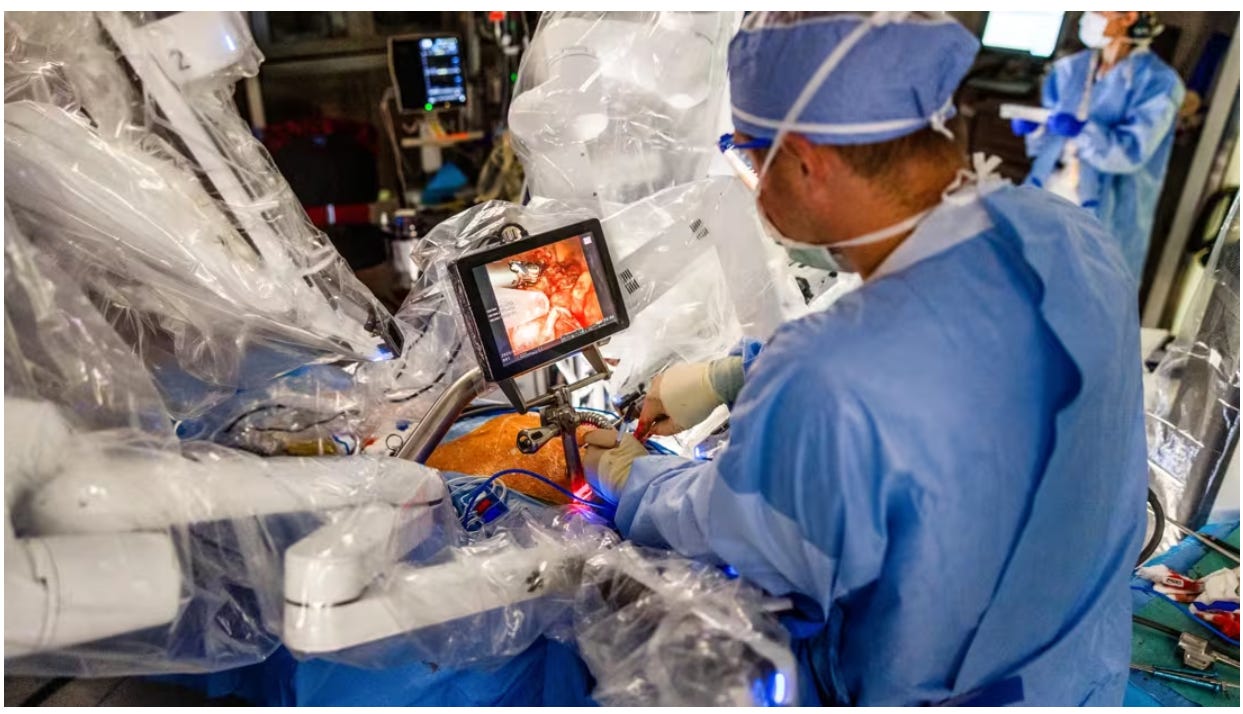
Our heart is inextricably linked with our vitality, and given its central role, it’s easy to understand why heart issues evoke such deep anxiety. Beyond that fear, though, is another unsettling reality: accessing the heart surgically has historically required opening the chest. For critical conditions like calcified heart valves, direct access has been an unavoidable standard of care. It’s understandably terrifying.
But what if open-heart surgery could be performed with no chest incision? Sounds like science fiction, right? Well, the Cleveland Clinic, lead by cardiothoracic surgeon Dr. Marijan Koprivanac and colleagues, have successfully replaced a diseased aortic heart valve using a robotic surgical system via a small incision in the neck. Four patients (ages 60–74) underwent this novel transcervical aortic valve replacement (AVR) approach. Incredibly, all four were up and active just a week after surgery, with minimal pain and only over-the-counter meds like ibuprofen or Tylenol for relief. One patient was even back to jogging on a treadmill one week post-op.
We’ll highlight all of this in the article.
First, if you enjoy these updates, consider subscribing and becoming a part of our growing community!
A New Path to the Heart
Traditionally, replacing an aortic valve required a surgeon to open the chest, either splitting the breastbone (sternotomy) or entering between the ribs (thoracotomy). These approaches, while effective, involve significant pain, healing time, and scarring. A newer alternative for some patients is TAVR (transcatheter aortic valve replacement), which threads a collapsible valve up to the heart through an artery (usually in the leg). TAVR avoids open surgery and offers faster recovery, but it doesn’t remove the old calcified valve and may not last as long or suit younger patients. Dr. Koprivanac’s transcervical robotic AVR is a bold attempt to combine the advantages of a surgical valve replacement (complete removal of the old valve and a durable new valve implanted) with the minimally invasive nature of a catheter procedure.
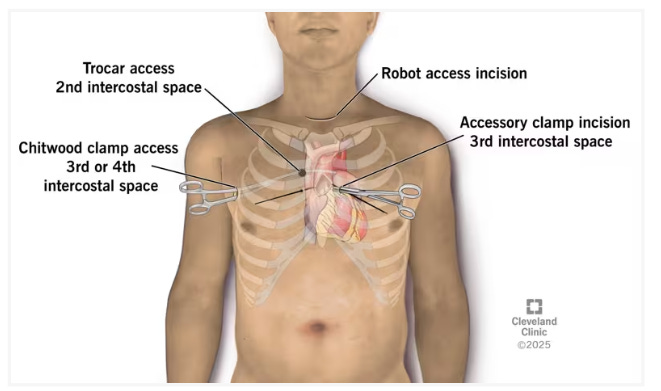
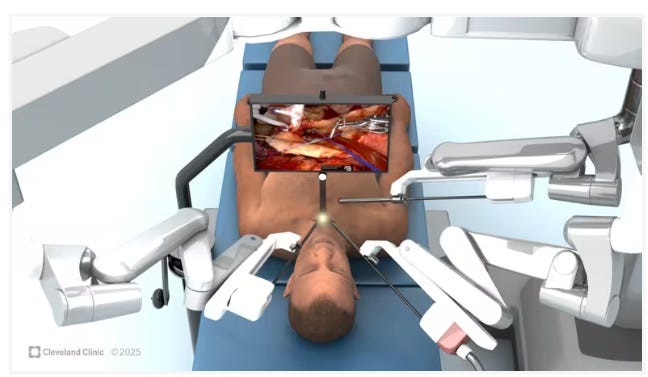
The key is accessing the heart from a small incision at the lower neck instead of the chest. This upper approach provides a direct view down to the aortic valve. Using the da Vinci robotic surgical system (a robotic platform with precise miniature instruments), the surgical team can operate through just four small incisions, the main one hidden in a neck crease (similar to a thyroid surgery incision), and three additional tiny ports for the robotic instruments and camera. Through these openings, the surgeons stop the heart’s circulation temporarily (using a heart-lung bypass machine and clamping the aorta) and meticulously remove the old diseased valve, clean out calcifications, and suture in a new valve, all internally, guided by high-definition 3D visualization. Essentially, they perform a full open-heart valve replacement without opening the chest at all.
This approach had only been tested in laboratory settings until now. Dr. Koprivanac first developed and optimized the technique on about 20 human cadavers in Cleveland Clinic’s anatomy lab to ensure it was feasible and safe. After refining the method (even designing special neck retractors and optimal port placements), the team offered it to select patients who needed isolated aortic valve replacement and were good candidates. The series of four patients treated earlier this year demonstrated that the transcervical robotic method is not only doable in live patients, but dramatically less invasive in terms of recovery.
Rapid Recovery Redefines “Open-Heart” Surgery
The recovery results from these initial cases have been extremely impressive. All four patients were out of the hospital in under a week (three went home after just 3–4 days, and the fourth by day 6). Because there were no chest incisions to heal, patients had no lifting restrictions or sternum precautions after discharge, they could move freely almost immediately. In fact, one 74-year-old patient felt so good that he resumed jogging at the gym one week post-surgery. Another patient was back to working on his farm within three weeks. As a side note, intense activity goes against all my instincts regarding any type of heart surgery. But this is echoed by Dr. Koprivanac as well, stating, “these types of activities are unimaginable so soon after other AVR approaches, even minimally invasive ones”. In a conventional open-chest valve surgery, patients often face 6–8 weeks of healing before they can fully exert themselves due to the split sternum. Even newer minimal incision surgeries don’t come close to this kind of rapid, pain-free recovery.
Pain control was impressively minimal. Patients reported only low-level discomfort, managed with acetaminophen and ibuprofen. None of them needed opioid pain medications. By a week after surgery, they were essentially pain-free and back to normal daily activities. For context, that’s a stark contrast to the slow and often uncomfortable convalescence after a typical open-heart operation.
Importantly, the surgical quality was not sacrificed for this less invasive approach. The team was able to fully remove the old hardened valves and implant new prosthetic valves securely in all cases, just as in a standard surgical AVR. Only one patient experienced a significant complication: an electrical disturbance called complete heart block (a known risk in any aortic valve procedure), which required a pacemaker implant. That patient’s hospital stay was 6 days, slightly longer than the others, but he otherwise did well. The other three had no complications. By leveraging robotics and a neck entry, the surgeons achieved outcomes comparable to traditional surgery while dramatically easing the recovery process.
Dr. Marc Gillinov, Chair of Thoracic and Cardiovascular Surgery at Cleveland Clinic, proudly announced the achievement as “an important advance in cardiac surgery — the first surgical aortic valve replacement with no incisions in the chest.” In essence, it’s the least invasive form of open-heart surgery ever performed for a valve replacement. Dr. Samir Kapadia, Cleveland Clinic’s Chair of Cardiovascular Medicine, agrees, calling it “a great advancement in minimally invasive surgical treatment for aortic stenosis.” He adds that this approach could be preferred by patients in the future “if it delivers similar safety and efficacy as other, more-invasive surgeries.” Early signs indicate that it can.
These newsletters take significant effort to put together and are totally for the reader's benefit. If you find these explorations valuable, there are multiple ways to show your support:
Engage: Like or comment on posts to join the conversation.
Subscribe: Never miss an update by subscribing to the Substack.
Share: Help spread the word by sharing posts with friends directly or on social media.
References:
https://consultqd.clevelandclinic.org/worlds-first-transcervical-robotic-avr-procedures
I love stories like this.
It's cool to see TAVR being advanced.